Showing posts with label Poles. Show all posts

Sunday, 30 June 2024

Gentleman Pensioners Sunday Game

 A couple of weeks ago I posted (link) that our Sunday game following the Phalanx Show would be an Eastern Renaissance battle.  What follows is a brief resume of that battle.  The situation was that an Allied army of Muscovites, Poles and Cossacks was trying to stop an Ottoman army (with some Tartar allies) from attacking the city of Kiev.

After a fairly ineffective exchange of long range artillery fire, the Ottoman forces began their advance.  The two Ottoman cavalry wings, preceded by a screen of skirmishing horse archers attempted to drive off the Allied horse archers.  In the centre a number of Azab units, both missile and melee moved forward, with Janissary units in a second wave.

Azab units about to cross the gully on the Ottoman right

The Ottoman advance was not very well co-ordinated (the Azabs could not be given brigade orders, so had to test unit by unit for movement), but did draw the fire of the Allied infantry, which was the Ottoman commander was hoping would happen.  One Azab unit did pay a heavy price, being routed before it could even fire it's opening volley.


An Azab unit routed by losses from artillery and musketry

On the Ottoman left, the cavalry battle was fierce, with several units destroyed, but the Ottoman commander was drawing more and more of the Allied cavalry into the fight. 


As the Ottoman infantry neared the Allied centre the Allied units were tempted to attack piecemeal, with varying results.
Ottoman infantry bearing down on the Allied centre

It was on the Allied left that the first real crisis came.  An Azab unit charged forward against the line of wagons covering the right flank of the Allied centre.  Through oversight, or ineptitude, the infantry commander had not garrisoned the wagons, so the only defenders were the gun crew.


They didn't offer much resistance and the chance was there for an attack on the flank of the Allied infantry.  Fortunately, the Azabs faltered and a small unit of Haiduk and a unit of Polish levy were able to drive them back.  The Allied left wing cavalry were also struggling.  After an initial success, they were repeatedly driven back, giving space for more and more Ottoman cavalry to cross the gully

The Ottoman right wing cavalry crossing the gully and pushing back
the Alliance left wing cavalry

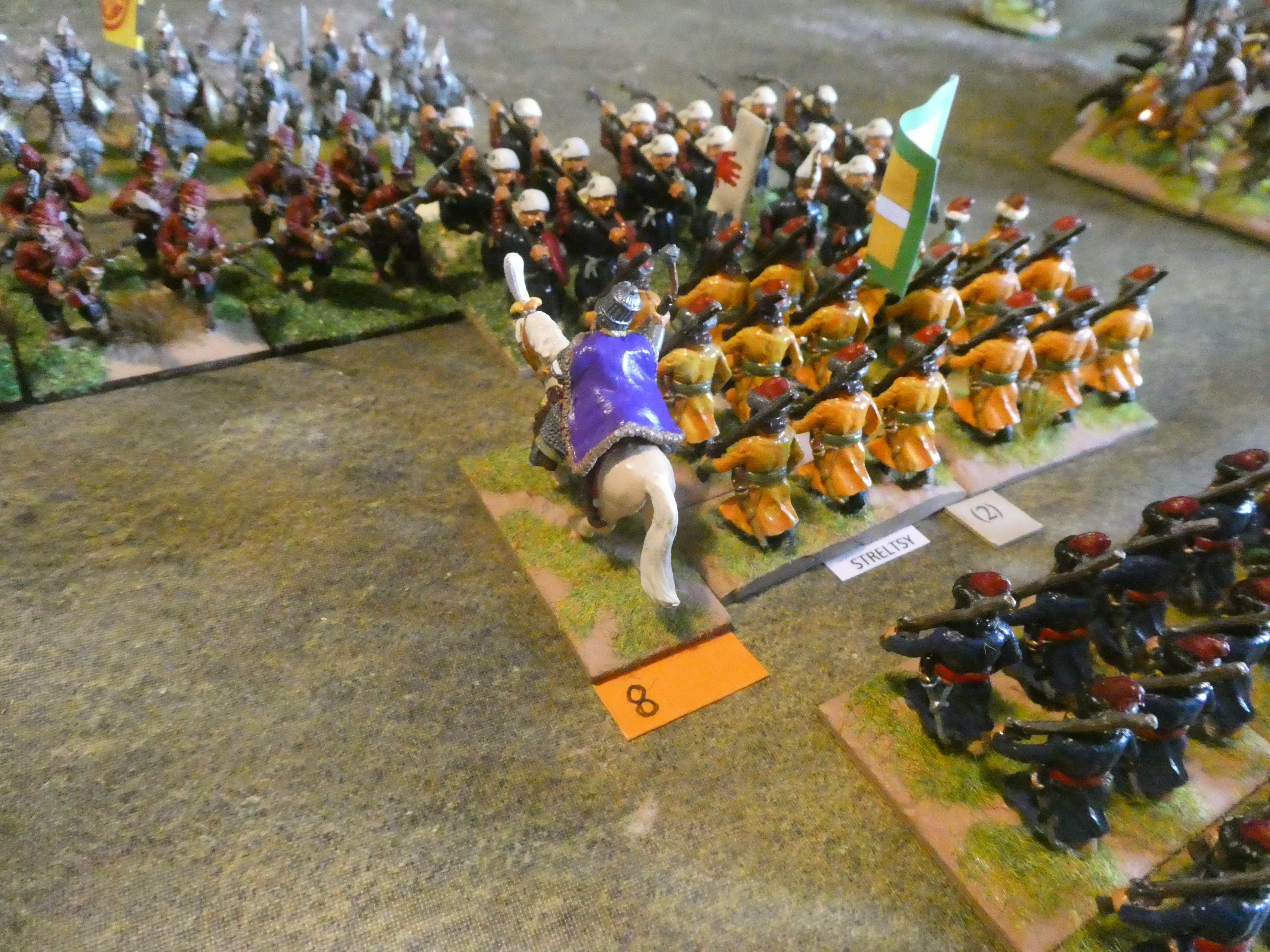
In the centre, one unit of Soldatski had been routed, but a unit of Streltsy moved forward to attack the Azab advance.

That Streltsy attack was successful, the Azabs routing.  However, behind them were units of Janissaries and they proved a tougher nut to crack. 

Not invincible though, as a unit of Cossacks proved on the left.


By mid - late afternoon, after 4-5 hours of gaming the Ottomans had made some progress.  On both flanks their cavalry had the upper hand.  In the centre, although they had taken losses, the Allied formation had broken up with units making un co-ordinated attacks.  A third wave of janissaries and the Sipahi of the Porte were available to exploit any gaps.  For their part, the Allied army had committed most of their infantry and also some of their cavalry reserve.

The Allied left


The Boyar cavalry on the Alliance right are committed to hold
back the Ottoman light cavalry


However, approaching are the provincial sipahi


The participating Gentlemen Pensioners
Will, Chris, David, John and Steve

A most enjoyable game.  Thanks to Steve for hosting and organising things and to Gwen, his wife, for the lovely lunch.   Thanks also to Will, Chris and John who although not familiar with the rules made the game the success it was.

Saturday, 15 June 2024

Gentleman Pensioners Weekend 2024

 The weekend of the Phalanx Show at St Helens is coming up soon.  Once again we will be running a game in support of the Lance and Longbow Society, this year provided by Will.  On the Sunday, Steve usually hosts a game and this year it will be an Eastern Renaissance 'bash'.

We will be using Steve's 8 x 6 table and almost 1000 25mm figures.  The battle will involve an Ottoman army, with some Tartar allies confronting an 'Alliance' army of Muscovite, Cossack and Polish/Lithuanian troops.  Here are a few photos of the initial deployment.

View along the table from behind the Alliance left wing


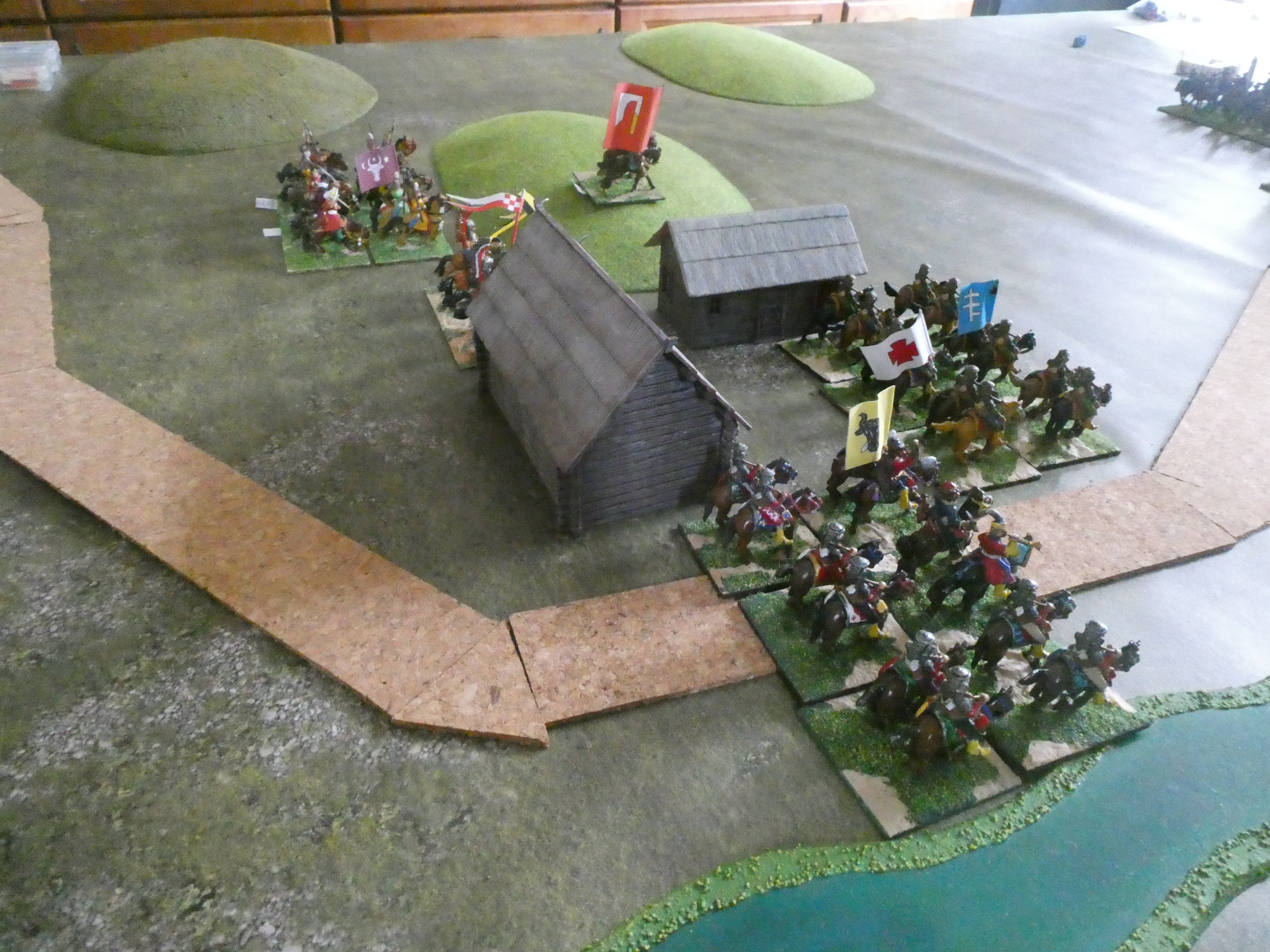
The Alliance centre flanked by wagons


The Ottoman centre, Janissaries and Spahi of the Porte

Ottoman right flank

Soldatski and Cossack foot

Hopefully, a report of the show and the Sunday battle will appear in a fortnight's time.


Friday, 15 September 2023

Another Deluge scenario: the Battle of Wojnicz, 3rd October 1655.

 It has been a while since my last post, real life intervened as it is prone to do from time to time.  This scenario is a follow up to my previous one and concerns the campaigns of King Charles X of Sweden against the main Polish Crown army.  Details have again been taken from volume 2 of "Charles X's Wars" by Michael Fredholm von Essen, which is published by Helion.   

Having heard that the Poles were in and around Wojnicz, Charles led a force of c 5,200 men, (the vast majority being cavalry) in that direction.  The Polish army under the command of Hetman Stanislaw Lanckoronski was slightly larger, numbering c 6,200 men all mounted.

After an initial skirmish between the outposts the two forces deployed.  The Poles deployed in three divisions, pancerni on the wings and hussars and pancerni in the centre.  A regiment of dragoons was ordered to defend the camp.  The Swedes placed their cavalry on the wings and the centre was held by dismounted dragoons and a few infantry, which took advantage of "a defensible gorge"


A view of the table with the Swedes on the left

.The objective for the Poles is to drive back the Swedes and protect their camp; for the Swedes, they would like to break this part of the Crown army and capture the baggage, so both sides need to attack  I rated the Swedish horse as slightly better than the pancerni, but not as tough as the hussars.  There was only one small unit of hussars and the bonus for lance only counted in the first charge.  To account for the "defensible gorge", any defenders would gain the benefit of the attackers charge bonus being nullified.  The dragoons in the Polish camp counted as being in hard cover.  The cavalry wings each had 4 regiments and the Polish centre had one unit of hussars and one of noble levy.  I used the levy mainly because I didn't have enough pancerni.  It did weaken the Poles slightly, but they did have more units.

First the Poles win


Then the Swedes

The Hussars prevail

The Swedes won the initiative and moved forward, as did the Poles.  Battle was soon joined and the Swedish right, which had two veteran units began to gain the upper hand.  The Polish centre decided not to charge the Swedish dragoons, but moved to bolster the Polish right which was coming under pressure from the Swedish left.  As usually happens the Polish hussars charge proved  unstoppable and they overcame two Swedish units.  However, they became isolated and were overwhelmed.  By now the Polish left had disintegrated and losses on the right were high so a Swedish victory was declared.

A rare sight, routing hussars


After lunch we swapped sides and ran the scenario again.  Once again the Polish right was in trouble and needed the centre to help them out.  One notable event was when a fresh unit of Swedish horse charged a small, shaken unit of Polish noble levy.  In the melee the Poles inflicted no hits on their opponents while receiving 8 in return.  Against the odds they managed to save all 8, but as they were shaken in a drawn melee they had to take a break test.  This came up double one so they routed.  Once lady luck proved how fickle she can be!

Historically the battle was a Swedish victory and the Poles lost their baggage and also parts of their army changed sides.  The catalyst for the loss was the unsuccessful charge by the hussars against the dismounted dragoons.  The leader of the hussars was Prince Dymitri Wisnniowiecki and being young and inexperienced perhaps his enthusiasm overcame his common sense.  Among the Poles who changed sides was one Jan Sobieski who later went on to be king of Poland.


Saturday, 29 July 2023

The Battle of Golab (Golomb) 1656. An Eastern Renaissance scenario for Pike and Shotte

 This week's game is a scenario set in the 'Deluge' when Poland/Lithuania was beset by enemies on all fronts.  The basic details come from Michael Fredholm von Essen's book "Charles X's Wars, Volume 2 The Wars in the East, 1655-57 which is publish by Helion in their Century of the Soldier series.

In early February 1656, King Charles X of Sweden moved south with an all cavalry force, hearing that a Polish force under Czarnieecki was close he set out to attack it.  On the 18th February he crossed the Vistula (which was frozen) and surprised and defeated a Commonwealth unit.  This retreated north, pursued by the Swedish vanguard commanded by General Henrik Horn.  At the village of Golab (or Golomb as it was known to the Swedes) they met the remainder of Czarniecki's force.  A general battle developed, with both sides receiving reinforcements.  Eventually superior numbers allowed the Swedes to outflank the Commonwealth troops and threaten their line of retreat.  When Czarniecki ordered a retreat it became more of a rout, as the Commonwealth troops were vigorously pursued by the  Lithuanian and Tartar units in the Swedish force.

The view from behind the Swedish vanguard

It is difficult to determine exact numbers involved in the action.  Charles had approximately 11000 men in his force when he set out, (8000 Swedes/Germans and 3000 Polish, Lithuanian, Tartar and Ruthenian  allies).  This will have dwindled during the campaign and not all the force was present at the battle.  What can be said is that the Swedish force was certainly more numerous than the c2500 Commonwealth troops under Czarniecki's command.

For the scenario I decided on the following forces

Swedish vanguard

2 standard units of Swedish Horse                 2 standard units of 'Cossack' cavalry

Swedish reinforcements

2 veteran units of  Swedish Horse (1 standard, 1 small)        1 standard unit of Lithuanian pancerni

2 standard units of Polish noble levy cavalry 


Commonwealth vanguard

2 standard units of Pancerni                       1 standard unit of Transylvanian light cavalry

1 very small unit of veteran Hussars

Commonwealth reinforcements

2 standard units of veteran pancerni                 1 small unit of veteran Hussars

Notes

Veteran Swedish and Commonwealth pancerni units were  rated 'Stubborn'

Hussars and the Lithuanian pancerni were given 'lance', but this was only available for their first charge.

Polish Noble Levy and Transylvanian cavalry started as trained but dropped to raw after they became 'Shaken'

Overall, the Swedes had a 3:2 advantage in numbers, but the Commonwealth had more veteran troops. 

The Commonwealth vanguard at Golab

Our battle began with a rather uncoordinated advance by the Swedish force, which was met by a determined move forward by the Poles and their allies.  The first clashes took place between the pancerni and the Swedish horse and each side had a unit routed.

First round to the pancerni

With Cossack support, the Swedes prevail

The Cossack units continued forward, and into the Transylvanian light cavalry.  Perhaps the Transylvanians were rather unwilling allies, because they were driven off in no time at all with one unit of Cossacks hot on their heels.

The Cossacks gang up on the Transylvanians

Meanwhile the Polish Hussars now entered the fray  They were too late to save their allies, but they made short work of the unfortunate Cossack unit that was in their way.  Continuing forward, the Hussars now made a nuisance of themselves disrupting the advance of the main Swedish force which was now reaching the battlefield.

The Polish Hussars in action

At the opposite end of the battlefield a unit of Cossacks could also see the main enemy body approaching.  However, there was little they could do to delay them and so they fell back towards their supports.

A second wave of encounters now took place with units charging and counter-charging across the field.  Units became shaken and or disordered and by the time we had to call a halt it was the Poles who had the advantage.  

The Lithuanian Noble Levy attack the Pancerni

Looking back, I perhaps made the Poles too strong in proportion to the Swedes, another two units of Swedish horse would have made a significant difference.  The use of 'stubborn' for the veteran units seemed to work well as did the amendment to the morale state of the Lithuanian Noble Levy and Transylvanian units. Definitely food for thought for future scenarios for this period.


Sunday, 5 March 2023

Battle of Shklov, August 12th 1654

  By the treaty of Pereyaslav(1654),  between Muscovy and the Cossacks, the Ukraine fell under Muscovy suzerainty.  This led to heightened tensions between Muscovy and the Polish Lithuanian Commonwealth which saw the Ukraine as part of its territory. In the summer of 1654 the forces of Tsar Alexis I of Russia invaded the Polish Lithuanian Commonwealth, initiating the Thirteen Years War and proving to be the precursor to the Deluge, which devastated the Commonwealth over the next few years.  At the beginning of the campaigning season, the Poles sent two armies to recover the Ukraine, but these were held in check by the Cossaack forces with a little Muscovite assistance.  Rather than provide aid to the Cossacks, Alexis had made his main effort directly against Lithuania and the main Muscovite army under his personal command was directed westwards towards Smolensk.

To oppose this force, (estimated to be 30-40,000 men), the local commander, Hetman Janusz Radziwill, could at best assemble 11,000 men, but as this was 'paper strength' the actual numbers were probably considerably lower.  As the Muscovite army advanced Radziwill moved what troops he had eastwards to try and hold the line of the Dneiper near Shklov.  For this scenario, which represented the clash of the Muscovite advanced guard and Radziwill's force, I selected the following forces.

Muscovy

Three brigades of cavalry; two with three 'regiments' of Old-Style cavalry and one with one regiment of Old-Style cavalry and two 'New Formation' regiments.  These latter regiments were similar to the western reiter regiments.

Poland Lithuania

Three units of pancerni type Cossack cavalry.  Two small dragoon regiments and a small Hussar regiment.  

The table layout, with the Russians nearest the camera

The Muscovite force arrives along the road leading to the bridge over the Dneiper.  The three brigades are strung out along the road with gaps between each brigade decided by rolling a d3, the result being the number of turns before the next brigade arrives.  The river is fordable but units may become disorganised.  Pancerni and  New Formation regiments are classed as tough fighters and may re-roll one failed attack dice per round of melee.  'Old-Style' cavalry are raw and cannot be issued a brigade order, making coordinated movement difficult.  Nor surprisingly the Hussar unit is tough, having the lance modifier and also the heavy cavalry bonus.  They are also classed as stubborn, allowing them to re-roll one failed morale save when in melee and being shot at. 
 

The pancerni await the attack 

The Muscovite objective was to cross the river, disperse the enemy and make all speed towards Smolensk.  On the Polish Lithuanian side the objective was to try and prevent passage of the river if possible, but more importantly, not to lose too many troops by making suicidal attacks.

The leading 'brigade' of Russian troops advance to the bridge 


As the attackers, the Muscovites had the initiative and unfortunately for them, their lead unit did not press on across the bridge, but sat and waited for the other units to form up on their flanks.  This gave Radziwill a chance to push his men forward and be in a position to hit the Muscovites as they crossed the river.  The leading brigade paid dearly for this hesitation with the first regiment across being charged before it could reform.  Although it held the first impact, it was shaken and in the subsequent round of melee it was driven back across the Dneiper in rout.


The first attempt to cross the Dneiper

By now the second brigade of Muscovite troops was arriving and this contained the New Formation regiments.  The overall commander of the advanced guard, Prince Yakov Cherkassky sent these units to the right of the bridge, trying to outflank the Polish Lithuanian defenders.  This manoeuvre pushed back a unit of Polish dragoons who had been adding their fire to the defence of the river line.  Afraid of being flanked they took up position on a hill on the Polish Lithuanian left.  To plug the gap, Radziwill committed his reserve pancerni regiment.  It was only just in time as Cherkassky sent four units of cavalry across the river, so each of the Polish Lithuanian regiments was now engaged in melee.  The Hussars dealt with their opponent fairly quickly, but the pancerni unit to their left took a lot of casualties.  Even though they were victorious they had to fall back to rally.  


Another attempt on the other side of the bridge

Beyond the bridge the New Formation cavalry regiments had entered the fray and proved tougher opponents than the Old Style regiments.  In the melee on the left of the Polish Lithuanian line the two units slugged it out and in the end both had to fall back to reform.   The other New Formation cavalry regiment defeated the pancerni, routing them, but at a cost, meaning they needed to reform before they could move forward.  


The 'new formation' cavalry enter the fray

The Third brigade of Muscovite cavalry now arrived and were able to take advantage of the work of their comrades.  Although disordered by crossing the river they nevertheless were unopposed.  Pressure on the Polish Lithuanian force was increasing and the line was buckling.  A second pancerni unit being routed decided Radziwill; better to pull back what forces he had than risk losing them all against such numbers.


A decisive breakthrough

A victory for the Muscovites, as historically.  Both sides claimed a victory.  Radziwill, because historically Cherkassky did delay his advance by a day; Cherkassky because he was able to cross the river.  The historic order of battle did give the Polish Lithuanians two full strength units of dragoons whose fire was very effective in breaking up the Old Style cavalry attacks.  Unfortunately I did not have sufficient figures to field two full strength units.
I did try and mitigate the lance effect of the Polish Hussars.  The lances they carried were hollow and reports suggest they tended to shatter on impact, so the lance 'bonus' was only available for one charge.  I did provide a wagon with a resupply of lances (just sufficient for one 'resupply'), but in the event the Hussars did not get the chance to re-equip before the Polish Lithuanian line crumbled.
All the details for the battle came from Michael Fredholm Von Essen's book, "Charles X's Wars: volume 2 - The Wars in the East, 1655-1657."  which is available from Helion books.  


Friday, 18 February 2022

Battle of Lubar, 16th September 1660

The scenario for this week's game is based on the battle of Lubar, an episode in the 13 Years War between Poland-Lithuania and Muscovy.  There were a series of combats spread over a number of days and this scenario comes from the Tales from a Wargames Shed blog 17th Century scenarios  page (link).  It involves a Polish/Lithuanian attack on a redoubt covering the flank of the main Muscovite camp.  There are only 10 units per side which makes it ideal for an evening game.  Statistics can be found on the blog for several rulesets, including our own preferred "Pike and Shotte".

The Polish/Lithuanian force has 4 'foreign' (ie mixed pike and shot) infantry units, 2 units of pancerni and one each of reiter, hussars and dragoons; and one field gun.  The Muscovite force has 3 units of infantry, one each of streltsy, soldatski and border dragoons, plus 2 light guns and a medium gun.  For cavalry they had two units of feudal levy cavalry and two of reiter.  I don't have sufficient foreign infantry or reiter so some of my ECW collection was pressed into service to fill out the roster.

The Muscovite objective is to try and hold the redoubt and thus protect the camp.  For the Polish/Lithuanians the seizure of the redoubt is a preliminary to the main attack on the camp. The Muscovites deploy first and opted to place the border dragoons in the camp with the medium gun and the Soldatski covering the gap between the emplacement on the hill and the camp.  On their right they placed all their cavalry, leaving the streltsi and light guns to garrison the redoubt.  For the Polish/Lithuanians the infantry and medium gun were deployed to attack the redoubt, the cavalry on the right to face the Muscovite cavalry, leaving the dragoons to occupy the attention of the border dragoons.


The Border dragoons defend the camp

The Muscovite commander seized the initiative and moved his feudal levy forward, with the reiter following in support.  Not willing to cede too much ground, the Polish commander ordered his pancerni to charge the oncoming Muscovites.  One unit of pancerni routed their opponents, though at the cost of heavy casualties.  The other melee was more prolonged with both participants slugging it out.

The feudal levy


The pancerni

Meanwhile the Polish infantry had advanced (rather sluggishly it has to be admitted), toward the redoubt, their reluctance probably the result of some accurate artillery fire from the Muscovite guns, backed up by volleys from the streltsi.  One unit was forced to fall back to recover from its casualties, leaving just one to charge the redoubt.  Their attack didn't reach the ramparts, the devastating fire from the defenders routing the attackers before they could strike home.


The first attack on the redoubt is repulsed

Undaunted the Polish infantry commander launched a second attack, both units charged, but once again the defenders fire stopped them in their tracks.

The second attack also fails

On the flank, the cavalry duel continued.  The Muscovite commander brought forward his reiter and the pancerni who had driven off the feudal levy counter-charged them.  In a rather one-sided melee the pancerni were driven from the field and the Polish cavalry commander had to commit his hussars to try and stem the tide.  Perhaps over-eager, the hussars became disorganised as they charged forward and thus their impact was not as decisive as it should have been.  Against the odds, the reiter held and were then reinforced by the second regiment.

The Hussars charge the reiter

On the hussars' left, the remaining feudal cavalry had driven back the pancerni and therefore the Polish cavalry commander had to commit his reserve, the reiter to try and buy time for the pancerni to recover.  Their performance was a disappointment.  Even though the feudal cavalry received the charge at the halt, they beat off the Polish reiter, inflicting such heavy casualties that they fled the field.  Things did not improve for the Poles, as the vaunted hussars were overwhelmed by the combined efforts of both Muscovite reiter units and they joined the growing number of Polish cavalry units fleeing the field.
  
But when the reiter are reinforced, it proves too much

At least the Polish dragoons were occupying the attention of the border dragoons and also one of the foreign regiments disordered the soldatski with a volley and then advanced towards them.  A second volley routed them, opening up the flank of the redoubt.

The soldatski break
Even the attack on the redoubt was at last making progress.  The defending streltsi had been gradually whittled down by volleys from the foreign regiments and eventually they routed.  Seizing their chance one of the foreign regiments charged forward and when one of the light guns disabled itself with a final shot, they were able to take the redoubt.

The redoubt is finally taken
It counted for nothing as on the flank, the Muscovite cavalry had achieved complete control.  A final, desperate charge by the remaining pancerni regiment had checked one of the reiter regiments, but at a cost of themselves taking horrendous casualties and routing from the field.  The Poles cobbled together a flank with one foreign regiment and the gun facing the cavalry, but there was really no alternative but to retreat.  A Muscovite victory was declared.

A most enjoyable scenario where the Polish advantage in numbers was offset by the Muscovite defences.  As always there were points in the game where things could have gone differently, but we both felt we had a chance of victory.

Saturday, 10 October 2020

Mesto Vody: an Eastern Renaissance scenario for Pike and Shotte

Although Steve and I have settled on Pike and Shotte (or at least our version of it) as our rules for this period we do look at other rule sets to see if there are any mechanisms which could be transferred.  One set which I have looked at is "By Fire and Sword" by Wargamer. One thing that caught my attention was the way in which they dealt with the various categories of firearms.  They make provision for the quality of the firearms, giving the better quality ones a greater range.  Therefore, a standard musket has a range of say 18" whereas a poor quality firearm has a range of 12".  We thought we could use this to reflect the variable quality of equipment of levy, militia and standing units within the Eastern theatre; this game was a trial of that idea.  A mixed Polish/Cossack force is raiding into Muscovite territory in response to an earlier incursion by the Muscovites.  It comprises of two Cossack infantry units, one of registered Cossacks and one of moloisty and two Polish infantry units, a "foreign regiment" and a Lan militia unit.  They have a light gun to support them and four units of cavalry, 2 of pancerni and two of Cossack light cavalry.  In response the local Muscovite boyar has assembled 3 local infantry units, two units of servant Cossacks and a unit of border dragoons.  He has been joined by the commander of the local garrison commander with a Soldatski unit, a unit of urban streltsy and a light gun.  There are also four units of cavalry, two of feudal cavalry and two of light cavalry. 

The initial set up, Polish/Cossack forces in foreground

The Muscovite force had deployed by the settlement of Mesto Vody to block and repulse the Polish/Cossack raid.


The Polish Lan regiment

The battle began with a swift advance by the Cossack infantry, the Poles seemingly more reluctant to move forward.  On the Polish/Cossack left one unit of Pancerni advanced further than the rest, but it's isolation was ignored by the waiting Muscovite cavalry, the first of several failures by their commander.  
The Muscovite commander with a unit of servant Cossacks beyond

The Cossack infantry were now coming into musket range of the Soldatski, but they chose to wait, rather than fire at long range.  On the left the Polish cavalry had managed  organise their advance and were now closing in on the Muscovite cavalry.  
The Cossack infantry near the Muscovite line

The Pancerni charged and caught a unit of Muscovite light cavalry before they could move.  Caught at such a disadvantage, the light cavalry had little chance and were pushed back.  Charged again before they could rally, the Muscovites quit the field, however, the Pancerni resisted the urge to pursue and re-dressed their ranks. 

The Pancerni stike

Matters were looking slightly better for the Muscovites in the centre.  The Soldatski's first volley was sufficient to disorder the Registered Cossack unit facing them.  A second inflicted more casualties and forced the Cossacks to halt to rally.  On the extreme right, the Moloisty unit was coming under fire from the Muscovite light gun and also a small unit of Border Dragoons ensconced in the buildings of Mesto Vody.  The Polish infantry had now moved up onto the left flank of the Registered Cossacks and into range of the Streltsy and Servant Cossack units.  Even though the Servant Cossacks had poor quality firearms and were therefore firing at long range they managed to inflict losses on the Lan infantry, whose return fire was less effective.  Volleys from the Streltsy disordered the Foreign Regiment before it could fire and the Polish light artillery was slow to get in position to support their infantry.  To the Muscovite commander it looked like the enemy infantry were beginning to waver and he ordered the Soldatski to charge.  They did charge, but not far enough to reach the enemy line, (we use variable move distances), and received a short range volley.  Fortunately for the Muscovites this was ineffective, the return volley was not and the Registered Cossacks took further casualties. Next turn the Soldatski charged, received another short range volley, but closed to melee.

The Soldatski charge falls short

The cavalry battle was now in full swing.  The remaining Muscovite light cavalry unit was charged by a Cossack unit, counter-charged and managed to defeat their opponents, pushing them back.  However, the  Muscovites now had to deal with the reserve Cossack unit which charged forward to cover their comrades while they rallied.  The feudal cavalry and Pancerni were also now locked in melee.


The cavalry battle in full swing

The feudal cavalry struggled against the Pancerni,   As they fought, the last Muscovite light cavalry unit broke and routed from the field.  The nearest feudal cavalry unit had just pulled back disordered from melee, as had the opposing Pancerni.  Before they could recover they were hit by the Cossacks and routed, with the Cossacks in pursuit.

The Muscovite light cavalry rout

Followed by one of the feudal cavalry units

In the infantry battle, the Soldatski were not fairing too well, (a roll of 5 '1's out of 7 dice did not help).  None of the other Muscovite infantry units had ventured forward  so the Soldatski were unsupported;  the Registered Cossacks meanwhile had two flank supports and this swung the balance.  The Soldatski fell back onto the hill, disordered.  Here they attempted to rally, but a volley from the Registered Cossacks proved too much and the Soldatski routed.

With the final feudal cavalry unit being overwhelmed by the two Pancerni units, the Muscovite infantry were now on their own.  The Steltsy had inflicted heavy losses on the foreign regiment and the Lan regiment had been hit hard by the fire from the Servant Cossacks, but without cavalry the position was hopeless and victory went to the Polish/Cossack force.

The final position

Discussing the game afterwards Steve and I thought that the new musketry rules had worked quite well.  Although the difference in effective range was only a matter of a few inches, the troops with the better quality firearms did get an advantage lacking in the standard Pike and Shotte rules.  The only area the poorer quality firearms achieved parity was at close range (set at pistol range), at that range we felt the quality of the firearms made no difference.

As for the Muscovite cavalry, they were at a disadvantage from the very start, or even before we started.  We had established that the respective C in C's would be rated '8' for command and that the two sub generals would roll for rating.  1/2 meaning a rating of '7' ; 3-6 '8'.  Both Polish/Cossack sub-commanders achieved '8' ratings, one of the Muscovite commanders rolled a '1'; that commander was of course for the cavalry.  Taken together with rating the feudal cavalry as militia, it meant that to move the cavalry had to get 2-6 on two d6, less than a 50% chance.  Hampered like that, they were always going to struggle.  Lesson for the future, try not to give militia to poor commanders!