Showing posts with label Cossacks. Show all posts

Sunday, 30 June 2024

Gentleman Pensioners Sunday Game

 A couple of weeks ago I posted (link) that our Sunday game following the Phalanx Show would be an Eastern Renaissance battle.  What follows is a brief resume of that battle.  The situation was that an Allied army of Muscovites, Poles and Cossacks was trying to stop an Ottoman army (with some Tartar allies) from attacking the city of Kiev.

After a fairly ineffective exchange of long range artillery fire, the Ottoman forces began their advance.  The two Ottoman cavalry wings, preceded by a screen of skirmishing horse archers attempted to drive off the Allied horse archers.  In the centre a number of Azab units, both missile and melee moved forward, with Janissary units in a second wave.

Azab units about to cross the gully on the Ottoman right

The Ottoman advance was not very well co-ordinated (the Azabs could not be given brigade orders, so had to test unit by unit for movement), but did draw the fire of the Allied infantry, which was the Ottoman commander was hoping would happen.  One Azab unit did pay a heavy price, being routed before it could even fire it's opening volley.


An Azab unit routed by losses from artillery and musketry

On the Ottoman left, the cavalry battle was fierce, with several units destroyed, but the Ottoman commander was drawing more and more of the Allied cavalry into the fight. 


As the Ottoman infantry neared the Allied centre the Allied units were tempted to attack piecemeal, with varying results.
Ottoman infantry bearing down on the Allied centre

It was on the Allied left that the first real crisis came.  An Azab unit charged forward against the line of wagons covering the right flank of the Allied centre.  Through oversight, or ineptitude, the infantry commander had not garrisoned the wagons, so the only defenders were the gun crew.


They didn't offer much resistance and the chance was there for an attack on the flank of the Allied infantry.  Fortunately, the Azabs faltered and a small unit of Haiduk and a unit of Polish levy were able to drive them back.  The Allied left wing cavalry were also struggling.  After an initial success, they were repeatedly driven back, giving space for more and more Ottoman cavalry to cross the gully

The Ottoman right wing cavalry crossing the gully and pushing back
the Alliance left wing cavalry

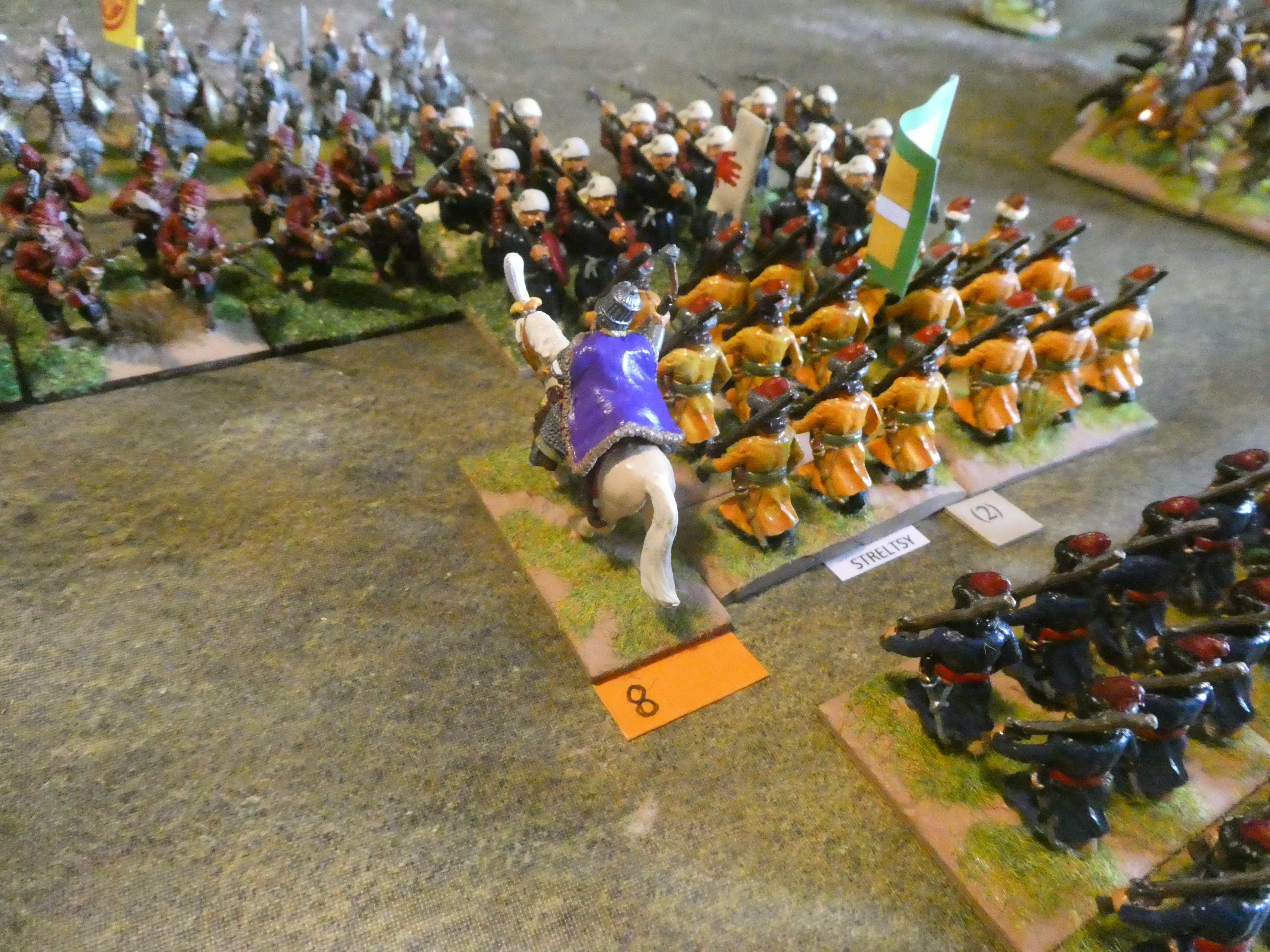
In the centre, one unit of Soldatski had been routed, but a unit of Streltsy moved forward to attack the Azab advance.

That Streltsy attack was successful, the Azabs routing.  However, behind them were units of Janissaries and they proved a tougher nut to crack. 

Not invincible though, as a unit of Cossacks proved on the left.


By mid - late afternoon, after 4-5 hours of gaming the Ottomans had made some progress.  On both flanks their cavalry had the upper hand.  In the centre, although they had taken losses, the Allied formation had broken up with units making un co-ordinated attacks.  A third wave of janissaries and the Sipahi of the Porte were available to exploit any gaps.  For their part, the Allied army had committed most of their infantry and also some of their cavalry reserve.

The Allied left


The Boyar cavalry on the Alliance right are committed to hold
back the Ottoman light cavalry


However, approaching are the provincial sipahi


The participating Gentlemen Pensioners
Will, Chris, David, John and Steve

A most enjoyable game.  Thanks to Steve for hosting and organising things and to Gwen, his wife, for the lovely lunch.   Thanks also to Will, Chris and John who although not familiar with the rules made the game the success it was.

Saturday, 15 June 2024

Gentleman Pensioners Weekend 2024

 The weekend of the Phalanx Show at St Helens is coming up soon.  Once again we will be running a game in support of the Lance and Longbow Society, this year provided by Will.  On the Sunday, Steve usually hosts a game and this year it will be an Eastern Renaissance 'bash'.

We will be using Steve's 8 x 6 table and almost 1000 25mm figures.  The battle will involve an Ottoman army, with some Tartar allies confronting an 'Alliance' army of Muscovite, Cossack and Polish/Lithuanian troops.  Here are a few photos of the initial deployment.

View along the table from behind the Alliance left wing


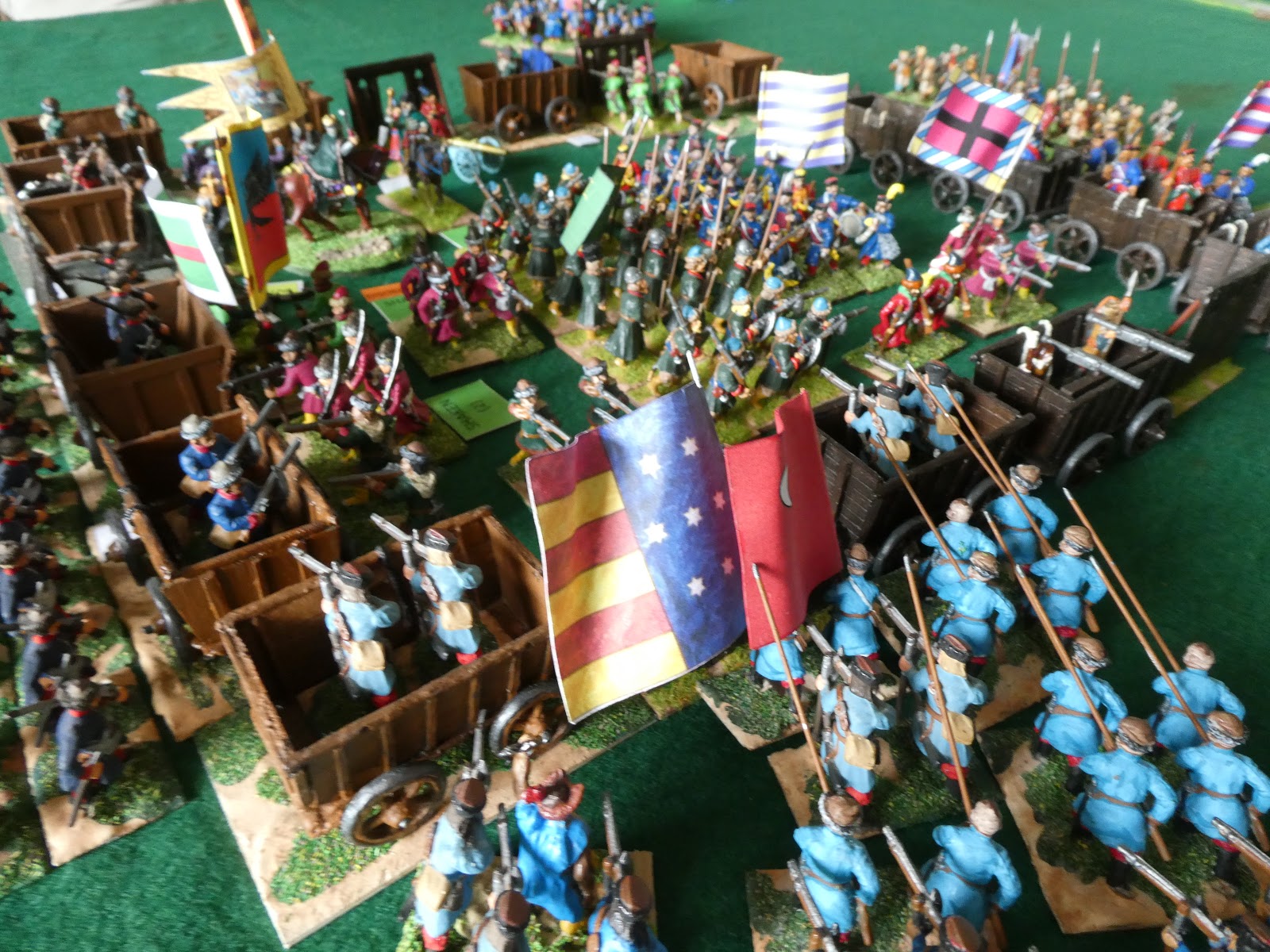
The Alliance centre flanked by wagons


The Ottoman centre, Janissaries and Spahi of the Porte

Ottoman right flank

Soldatski and Cossack foot

Hopefully, a report of the show and the Sunday battle will appear in a fortnight's time.


Monday, 4 January 2021

Border patrol: an eastern renaissance scenario for Pike and Shotte

 Just before Christmas Steve and I managed to fit in a skype game.  I drew up a scenario where a unit of Muscovite border dragoons had been carrying out a patrol, watching the Cossack lands for any signs of impending raids.  Unfortunately, they strayed too close to the Cossack settlement and failing to get away, ended up in an old border fort.  A messenger had managed to get away and he roused the local provincial Muscovite forces to come to the rescue.  The Muscovite force consisted of two units of light cavalry, two of feudal cavalry, two units of urban streltsy and two of servant Cossacks. 

The initial set up of the Cossack force


Cossack force keeping an eye the fort

The Cossack commander had been told by his scouts that the Muscovites were on the way and drew up his force to cover the fort.  He had two units of Moloisty, a unit of Cossack musketeers and a small composite unit which was to keep an eye on the fort and stop the border dragoons sallying out.  In addition he had four units of light cavalry.  On the right was a unit of cavalry, the centre was held by the infantry, the musketeers between the units of moloisty.  Two cavalry units were on the left with the final unit held in reserve.  The Muscovite commander received reports of the Cossack deployment and decided to place all his cavalry on the right.  His four units of infantry were to advance and pin the Cossack foot whilst his cavalry, having the advantage of the weightier feudal cavalry would disperse the Cossack cavalry and then sweep round and envelop the Cossack line.

The Muscovite infantry prepare to advance

The Border Dragoons line the walls of the fort

The action began with the Muscovite light cavalry moving quickly forward, although the feudal cavalry were a little more cautious.  As he saw the mass of Muscovite cavalry bearing down on his left flank, the Cossack commander quickly galloped over to the right and led the unit of cavalry there across the battlefield to support the left wing.  Action was quickly joined with the Cossacks gaining the upper hand.  One unit of Muscovite light cavalry routed, the other held on, mainly because a unit of feudal cavalry  joined them in the melee.  The successful Cossack cavalry pursued their defeated opponents straight into the second unit of feudal cavalry.  In the resulting melee both sides fought themselves to a standstill and had to fall back to reform and rally. 

The Muscovites rout

One of the moloisty units had drifted across to the left, it's commander thinking its presence would support the cavalry and provide some fire support.  However, this did mean the Cossack infantry in the centre and right were now outnumbered two to one; if the Muscovite commander could organise a coordinated advance the Cossack position would be perilous.  This was proving difficult as although the streltsy were advancing steadily, the servant cossacks were far more reluctant

Cavalry action on the Cossack left

Overview of the battlefield
On the Cossack left the former right wing cavalry were now committed to the fray.  Their intervention tilted the melee in the Cossack favour once more and eventually the Miuscovite light cavalry broke, routing to the rear and pulling the feudal cavalry with them.  There was no pursuit, the Cossacks had paid a heavy price for their victory and would take time to recover.
The Cossack reinforcements arrive on the left

Towards the centre, the Cossack light cavalry resumed the attack against the feudal cavalry they had tussled with earlier.  Although they caught the Muscovites whilst they were still rallying, the Cossacks were unable to push home their advantage and ended up suffering such heavy casualties they routed to the rear.


The infantry action had now begun.  As the streltsy came in range the Cossack musketeers fired a volley which inflicted heavy casualties on the advancing Muscovites.  Undaunted, the streltsy charged, only to receive more casualties as they closed and then suffer heavily in the melee.  Even the support of their fellow streltsy unit couldn't hold them in position and they fell back in disorder.  At this point, the reserve cavalry unit which the Cossack commander had brought forward to support the infantry, now charged the hapless streltsy.  Caught at a severe disadvantage, the streltsy were overwhelmed and routed from the field.

The Cossack cavalry rout the streltsy

Meanwhile the Cossack musketeers, buoyed by their success, decided to charge the second streltsy unit. Although the Cossacks survived the closing volley, the streltsy then employed their berdische axes to good effect, inflicting heavy casualties on their assailants.  It proved too much for the musketeers and they routed, eventually being rallied close to the fort by the Cossack commander.  The moloisty unit on the right had managed to disorder one of the servant Cossack units by musketry, but a volley from the streltsy had caused them to fall back disordered.

The Cossack musketeers rout.

Surveying the field the Muscovite commander was not convinced he would manage to reach the dragoons in the fort.  Although his infantry had achieved some success, his cavalry were spent.  He ordered the advance to cease and what remained of his force to fall back to reform.  For his part, the Cossack commander assessed that his force was on the brink of defeat. Although his cavalry had the upper hand, all the units needed time to reform.  His infantry was reduced in effectiveness and may not resist another attack.  He summoned  the dragoons to surrender, offering them safe passage to their lines in return for their firearms and horses.  His offer was accepted by the dragoon commander and after the surrender both sides withdrew under cover of darkness.

An enjoyable action which could have gone either way.  The Cossack cavalry did better than expected against the feudal cavalry, but the musketeers should really have relied on their musketry rather than attack the streltsy.  Both sides struggled to coordinate their infantry due to the number of raw, militia units. 

Saturday, 10 October 2020

Mesto Vody: an Eastern Renaissance scenario for Pike and Shotte

Although Steve and I have settled on Pike and Shotte (or at least our version of it) as our rules for this period we do look at other rule sets to see if there are any mechanisms which could be transferred.  One set which I have looked at is "By Fire and Sword" by Wargamer. One thing that caught my attention was the way in which they dealt with the various categories of firearms.  They make provision for the quality of the firearms, giving the better quality ones a greater range.  Therefore, a standard musket has a range of say 18" whereas a poor quality firearm has a range of 12".  We thought we could use this to reflect the variable quality of equipment of levy, militia and standing units within the Eastern theatre; this game was a trial of that idea.  A mixed Polish/Cossack force is raiding into Muscovite territory in response to an earlier incursion by the Muscovites.  It comprises of two Cossack infantry units, one of registered Cossacks and one of moloisty and two Polish infantry units, a "foreign regiment" and a Lan militia unit.  They have a light gun to support them and four units of cavalry, 2 of pancerni and two of Cossack light cavalry.  In response the local Muscovite boyar has assembled 3 local infantry units, two units of servant Cossacks and a unit of border dragoons.  He has been joined by the commander of the local garrison commander with a Soldatski unit, a unit of urban streltsy and a light gun.  There are also four units of cavalry, two of feudal cavalry and two of light cavalry. 

The initial set up, Polish/Cossack forces in foreground

The Muscovite force had deployed by the settlement of Mesto Vody to block and repulse the Polish/Cossack raid.


The Polish Lan regiment

The battle began with a swift advance by the Cossack infantry, the Poles seemingly more reluctant to move forward.  On the Polish/Cossack left one unit of Pancerni advanced further than the rest, but it's isolation was ignored by the waiting Muscovite cavalry, the first of several failures by their commander.  
The Muscovite commander with a unit of servant Cossacks beyond

The Cossack infantry were now coming into musket range of the Soldatski, but they chose to wait, rather than fire at long range.  On the left the Polish cavalry had managed  organise their advance and were now closing in on the Muscovite cavalry.  
The Cossack infantry near the Muscovite line

The Pancerni charged and caught a unit of Muscovite light cavalry before they could move.  Caught at such a disadvantage, the light cavalry had little chance and were pushed back.  Charged again before they could rally, the Muscovites quit the field, however, the Pancerni resisted the urge to pursue and re-dressed their ranks. 

The Pancerni stike

Matters were looking slightly better for the Muscovites in the centre.  The Soldatski's first volley was sufficient to disorder the Registered Cossack unit facing them.  A second inflicted more casualties and forced the Cossacks to halt to rally.  On the extreme right, the Moloisty unit was coming under fire from the Muscovite light gun and also a small unit of Border Dragoons ensconced in the buildings of Mesto Vody.  The Polish infantry had now moved up onto the left flank of the Registered Cossacks and into range of the Streltsy and Servant Cossack units.  Even though the Servant Cossacks had poor quality firearms and were therefore firing at long range they managed to inflict losses on the Lan infantry, whose return fire was less effective.  Volleys from the Streltsy disordered the Foreign Regiment before it could fire and the Polish light artillery was slow to get in position to support their infantry.  To the Muscovite commander it looked like the enemy infantry were beginning to waver and he ordered the Soldatski to charge.  They did charge, but not far enough to reach the enemy line, (we use variable move distances), and received a short range volley.  Fortunately for the Muscovites this was ineffective, the return volley was not and the Registered Cossacks took further casualties. Next turn the Soldatski charged, received another short range volley, but closed to melee.

The Soldatski charge falls short

The cavalry battle was now in full swing.  The remaining Muscovite light cavalry unit was charged by a Cossack unit, counter-charged and managed to defeat their opponents, pushing them back.  However, the  Muscovites now had to deal with the reserve Cossack unit which charged forward to cover their comrades while they rallied.  The feudal cavalry and Pancerni were also now locked in melee.


The cavalry battle in full swing

The feudal cavalry struggled against the Pancerni,   As they fought, the last Muscovite light cavalry unit broke and routed from the field.  The nearest feudal cavalry unit had just pulled back disordered from melee, as had the opposing Pancerni.  Before they could recover they were hit by the Cossacks and routed, with the Cossacks in pursuit.

The Muscovite light cavalry rout

Followed by one of the feudal cavalry units

In the infantry battle, the Soldatski were not fairing too well, (a roll of 5 '1's out of 7 dice did not help).  None of the other Muscovite infantry units had ventured forward  so the Soldatski were unsupported;  the Registered Cossacks meanwhile had two flank supports and this swung the balance.  The Soldatski fell back onto the hill, disordered.  Here they attempted to rally, but a volley from the Registered Cossacks proved too much and the Soldatski routed.

With the final feudal cavalry unit being overwhelmed by the two Pancerni units, the Muscovite infantry were now on their own.  The Steltsy had inflicted heavy losses on the foreign regiment and the Lan regiment had been hit hard by the fire from the Servant Cossacks, but without cavalry the position was hopeless and victory went to the Polish/Cossack force.

The final position

Discussing the game afterwards Steve and I thought that the new musketry rules had worked quite well.  Although the difference in effective range was only a matter of a few inches, the troops with the better quality firearms did get an advantage lacking in the standard Pike and Shotte rules.  The only area the poorer quality firearms achieved parity was at close range (set at pistol range), at that range we felt the quality of the firearms made no difference.

As for the Muscovite cavalry, they were at a disadvantage from the very start, or even before we started.  We had established that the respective C in C's would be rated '8' for command and that the two sub generals would roll for rating.  1/2 meaning a rating of '7' ; 3-6 '8'.  Both Polish/Cossack sub-commanders achieved '8' ratings, one of the Muscovite commanders rolled a '1'; that commander was of course for the cavalry.  Taken together with rating the feudal cavalry as militia, it meant that to move the cavalry had to get 2-6 on two d6, less than a 50% chance.  Hampered like that, they were always going to struggle.  Lesson for the future, try not to give militia to poor commanders!


Sunday, 4 August 2019

A bit of an experiment

Last week's game had a Gulay Gorod but in didn't really play a major part in the action.  In our after game chat Steve and I discussed some of the likely rules which we may need to devise to cope with an attack on the wagons formed up in a defensive square.


The wagons formed up
This week's game was the consequence of our chat.  A Muscovite force has been attacked in a frontier fort.  Attempting to return to mother Russia, they have broken through the encircling Cossacks and made their way north, only to find their way blocked by a Polish force.  This has allowed the pursuing Cossacks to catch up with them.  The Muscovite commander has formed his wagons into a square, hoping to hold off the attackers long enough for a relief force, (if the messenger got through), to arrive.  He has 2 units of Streltsy and one unit of Soldatski, plus a unit of feudal cavalry.  The defence is bolstered by a selection of light artillery both limbered and in some of the wagons.

For their part, the Poles and Cossacks recognise that cavalry are not going to break into the Gulay Gorod, it will be a job for the infantry.  They have therefore held their cavalry back to counter any sally by the Muscovite feudal cavalry whilst the infantry attack.


The first Cossack attack repulsed
Bad communication has resulted in the Cossack attack going in first before the Poles have advanced.  Good defensive fire disordered the initial Cossack attack and allowed the defence to  repel this first attack.  Seeking to drive off the Cossacks altogether, the Muscovite commander ordered his cavalry to sally out.  However, the Polish pancerni intervened, forcing the Muscovite to attack them. 

The sally by the feudal cavalry
Meanwhile the Polish infantry had attacked and the defensive fire had not been as effective.  The Haiduk units drove back the Streltsy, who fell back, disordering their supports.  Free from the threat of a cavalry attack the Cossack infantry returned to the attack and this time overwhelmed the defenders.  Although the feudal cavalry had driven back the pancerni, their was no avenue of escape for the infantry, all the Muscovite commander could do was surrender.

The Poles break in
As do the Coosacks
The feudal cavalry's victory counts for naught
Our deliberations after this game came up with some possible bonuses for the defenders within the Pike and Shotte rules.  These will be adjusted in the light of further trials.

Defenders

Gain +1 on save from missile fire due to cover of wagons

In melee gain +1 to saving roll for cover

Count as 'Stubborn' ie may re-roll one failed saving roll for both melee and missile losses. (once per turn for each category).

Stamina of unit increased by 1

If taking a break test get a +1 modifier

Sallies

A foot unit can be ordered to move an obstacle aside to allow a unit to leave the Gulay Gorod. Once the sallying unit leaves, roll 2 d6, if a blunder is rolled, gap remains open.


Artillery fire – incoming

Guns fire normally, however, light artillery need to be within half maximum distance (ie using 2 d6) in order to damage wagons. Scores of 5/6 are potential hits on occupants of wagons. 4 a possible hit on wagon itself. Roll again for each potential hit, score of 4+ inflicts 1 damage point on wagon. Wagon has total of 3 points, after 3rd hit remove wagon and replace with wooden obstacle. Occupants have 50/50 chance of survival (no modifiers).
Hail shot cannot be used to damage a wagon, only against occupants.

[What about 'unclear target'? Targets qualify if they are in buildings or partly within sight]

Artillery fire – outgoing

Swivel guns – 180 degree arc. 12” range. No hail shot. Use only 1 d6. -1 modifier to save.

Light guns in wagons
Normal 45 degree arc. 18” max range. Use 3/2/1 dice as usual -2 on save.

Normal light guns
Fire as usual.