Wednesday, 15 June 2011
SYW Baltic scenario
Sunday, 5 June 2011
Trouble in the East
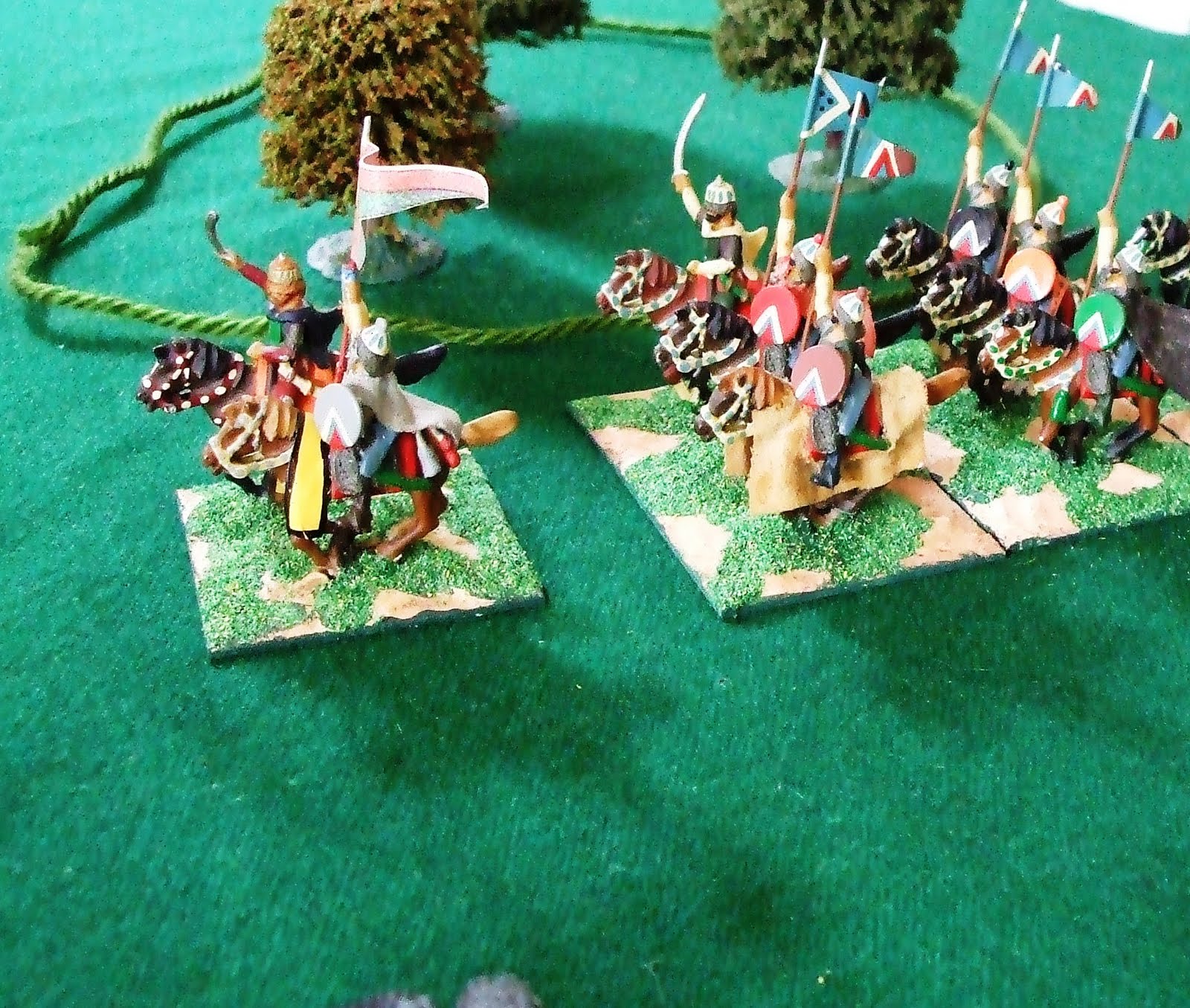
This work had not gone unnoticed by the local Cossacks of the Bolotnikov clan and a force had been assembled to destroy the works and push the Muscovites back over the river. Warned of the approaching Cossack force by his scouts, Pozharski moved his whole force south of the river to support the small detachment of streltsi covering construction. his force consisted of his own feudal cavalry, a unit of horse archers and three understrength streltsi units. In the already constructed redoubt was a field gun. As a precaution Pozharski had sent a messenger to Ivan Dolgoruki, a local boyar and distant cousin, requesting assistance.
Taras Bolotnikov, head of the clan, had gathered three units of cavalry supported by two units of horse archers, a unit of Zaporozhian musketeers, the lcoal levy, some registered cossacks and a light gun. His plan was for the infantry to secure the part constructed redoubt whilst the cavalry defeated the Muscovite cavalry.
Pozharski was confident his feudal cavalry would defeat their Cossack opponents and moved to closely direct his horse archers who were raw and newly raised. His concerns were well-founded as the lefthand unit was out-manouvred and pinned against the river, where it was cut down. The second unit was unsettled by arrows from the cossack horse archers and as Pozharski attempted to restore order the enemy charged. Pozharski and his standard bearer were engulfed in a swirling melee, where he and his men were outnumbered two to one. Fighting desperately, Pozharski looked for asistance from his feudal cavalry, but they were invovled in their own struggle with the main body of Cossack cavalry. Unable to escape, Pozharski went down fighting.
Meanwhile the attack on the southern redoubt had been progressing. The light gun had been inflicting casualties on the streltsi who could ill afford the losses. They managed to stop the first attack by the levy but the defenders were stretched very thinly and the Zaporozhians were moving around their left flank. Fortunately this brought them within range of the field gun on the northern bank and losses began to mount. Having defeated a second levy attack the Vorontzov Streltsi moved to support the Ivanov Streltsi who were invovled in an unequal firefight with the Zaporozhians. It was at this moment that Dolgoruki arrived with his reinforcements, a body of feudal cavalry and two units of streltsi.
The Muscovites were clinging on to the part contructed redoubt and the feudal cavalry were still fighting the main cossack cavalry, but the cossack horse archers were beginning to move across the river by a minor ford, threatening to attack the northern redoubt from the rear.
Bolotnikov saw the Muscovite reinforcements arriving and sent his last reserve of cavalry to attack the feudal cavalry as they came across the ford, delaying their advance as long as possible. Dolgoruki for his part sent one unit of streltsi to defend the northern redoubt and gave orders to the second to deploy to cover the ford from the northern bank. He then led his cavalry forward across the ford. On the far bank they were met by the Cossack cavalry and found it difficult to deploy to use their superior numbers and another protracted melee began.
In the redoubt the Zaporozhians had finally driven off the Ivanov Streltsi and closed up to the part completed works. The Vorontzov streltsi charged forward but were met by a telling volley and then driven back by the Zaporozhians. As the streltsi attempted to reform they were charged by the levy who had taken advantage of a gap in the defences to enter the works.
Still disorganised from their failed charge the streltsi were swept away by the levy and organised resistance in the part completed redoubt ended. The few remaining streltsi ran for their lives towards the ford. Dolgoruki had made some progress, driving off the cossack cavalry, but was now coming under fire from the levy musketeers. He struggled to form his men up to charge this 'rabble' because they could see streltsi running for the ford and also cossack horse archers on the northern bank. As the feudal cavalry milled about Bolotnikov gathered the few cavalry remaining from the successful fight with Pozharski's cavalry and charged. Caught at the halt and in disarray Dolgoruki's men broke and were pursued to the ford by the jubilant cossacks. The two undamaged streltsi units deterred any Cossack move across the river, but they were happy to take away the wagons of stores and an artillery piece from the redoubt
We used a few amendments to the 1644 rules for this 'eastern' scenario. Instead of charging in squadrons the feudal cavalry charge as a body and only count their second rank if the melee continues. This second rank does not get any impetus.
Monday, 30 May 2011
Triples 2011
Grimsby Wargames Club with their War of Spanish Succession scenario, using their home-grown rules Corporal John and the Sun King. The fortifications and entrenchments were very impressive.
There were two Lutzen games. Nice John and Evil Trev depicted the Thirty years war encounter
and Bramley Barn the napoelonic version.
I was helping out on the Lance & Longbow Society stand with their "Raid on Croix Saint" game. Bob Metcalfe provided some excellent ships, figures and buildings for the game which generated interest from visitors.
I was in command of the English fleet with the task of landing the raiding force. Light (or at times non existent) winds made manoeuvring difficult for both sides. Things were not helped by a certain laxity in the terminology used by the commanders. Too late we discovered that by saying our ships had collided we automatically ran the risk of sinking. After losing 5 ships we realised our mistake and began to claim that we were "coming alongside to grapple". By mid-afternoon I managed to land some troops and set fire to the village.
But by this time the 'locals' had raised the alarm and Breton troops were on their way.
Monday, 23 May 2011
Cerignola 1503
The Spanish force of 8000 was predominantly an infantry one, with a significant number of arquebusiers, backed up by blocks of pikes and swordsmen. The French force, (32000 strong), consisted of large bodies of heavy cavalry Gendarmes and Swiss pikes as the main strike force, supported by units of missile foot (predominatly crossbowmen).
Our refight gave the Spanish some small units of light cavalry which were used to harass the Gendarmes as they advanced. The homegrown rules we used required the army commanders to roll a d6 each turn to find the number of action points each general had to move units. The French had two generals, Louis and Chandieu, who commanded the Swiss. For the Spanish there was just one general, Gonzalo. With a command span of 18" this meant that units on the wings of the Spanish army would require double points to move, unless Gonzalo were to move from his position in the centre. However, as things turned out this did not prove too disadvantageous for the Spanish, as Gonzalo managed to consistently roll more command points on his one dice than the French did on their two! To avoid complete paralysis in this situation, the rules do allow for a unit which has previously been activated to continue to move at half speed without cost. Thus the French and Swiss infantry slowly, very slowly, lumbered forward. Louis' own light cavalry had been quickly dispersed by their Spanish opponents and then gallantly hampered the Gendarmes advance. In the end they were caught (mainly due to a lack of comand points) and quickly dealt with by the French heavy cavalry.
With this irritant removed the Gendarmes immediately moved towards the ridge, aiming directly for Gonzalo's standard in the centre. As they surged up the hill they discovered to their consternation the ditch and entrenchment. Instead of being able to overrun the arquebusiers they found that they were trapped in a shooting gallery. Instead of recording casulaties the rules simulate increasing disorder by causing stands of figures to be separated from the main body. To reform costs command points, so the decision needs to be taken whether to reform in place and regain strength, or fall back and then reform before returning to the fray. After a period of indecision (ie low dice rolls for command points), Louis decided to reform his Gendarmes behind the Swiss and let them clear the way. All this time the French missile foot and artillery had been struggling to advance, (in the end half the French guns never got into action at all).
The emphasis now moved to the Swiss, who advanced into the fire of the Spanish artillery and Arquebusiers with no supporting fire of their own. By the time they reached close quarters a third of their bases had been separated, but they still managed to gain entry to the position, forcing back the arquebusiers. (The rules give the missile foot a melee value equal to their close rage fire effect in the first round to simulate the final close range volley. If the melee continues there fighting value drops dramatically).
Just as Louis thought he was gaining the upper hand Gonzalo committed his reserve of pikes and these fresh troops pushed the Swiss back over the entrenchments and down the slope. As they attempted to reform the Swiss were subjected to more harassing fire from the Arquebusiers who had taken up their former position lining the entrenchments. As he saw his men struggling, Chandieu asked Louis angrily what the French crossbowmen were doing, "having their lunch perhaps?"
Louis did not respond, but in fact the crossbowmen had succeeded in moving forward far enough to engage with the arquebusiers on the French left. Supported by the artillery which had also manged to get forward, they eventually pushed the arquebusiers back and even managed to cross the entrenchments. Gonzalo was preoccupied on his left with the repulse of the Swiss and the reserves on the opposite flank were tardy in their response. The French crossbowmen, presented with such a prime target did not waste the opportunity and their fire disorganised the pikes, dissuading them from attacking. Now would have been the time for Louis to commit his reserve and perhaps win the day, but the Swiss and Gendarmes were in no shape for further action at the moment and were far away from the decisive point. So reluctantly, the French crossbowmen fell back, as did the remaining Swiss and Gendarmes.The Spanish had achieved a notable victory.
In spite of his heavy losses our Louis had improved on the historical result, mainly because he had survived the battle and his troops had managed to cross the entrenchments.
Thursday, 28 April 2011
Small Wars - Seven Years War
We started with three units of Austrian skirmishing light cavalry on the table, with the rest of the force due to arrive the next turn. Prussian forces were indicated on the umpire's map and only revealed as required. The first Prussian line of defence was based on the village of Neider Nahmen, a sunken, tree-lined road and the farm complex of Bauernhof.
The picture above shows Neider Nahmen, with the twin hills of Waldburg and the Langenburg beyond. The Bosniaks are positioned in the open area between Neider Nahmen and Der Grauhaus, which was the best cavalry country.
The Austrian Commander decided to use the bulk of his cavalry on his left, to swing around Neider Nahmen and surround any defenders and also scout ahead for any enemy forces. His Croat units would seize the village and farm and then reform before moving forward to the hills.
The Prussian commander had few troops at his disposal to delay the enemy, 3 Frei batallions, a unit of Jaeger, 2 units of regular Hussars, the Bosniaks and a unit of Frei hussaren. He garrisoned Bauernhof with frei battalion Le Noble with the jaeger in the sunken road on their flank. The remaining Frei battalions were held near the Langenberg, the regular hussars behind the Waldberg and the Frei Hussaren 'Favrat' held further back near the Grauhaus. As the action began, the only enemy the Austrian commander could see were the Bosniaks.
Colonel Tokacz led his unit of Banalisten Grenz Hussars round to the right, skirting Bauernhof and moving towards the Langenberg. As the Grenz Hussars passed the farm complex shots from the defenders caused a few casualties, but Tokacz pushed forward. Behind him the 1st battalion of the Gradiscaner Croat moved towards Bauernhof with the Ogaliner Croat batallion on their left.
On the left the Slavonishes and Warasdiner Grenz Hussars moved forward skirting Neider Nahmen and advancing towards the Bosniaks. In their wake the Liccaner, Creutzer and 2nd batallion Gradiscaner Croats moved towards Neider Nahmen, supported by the Jaeger Korps and Frei batallion Von Loudon and the regular Hussar regiments of Baranyey and Hadik.
Cautiously, the Croats approached the village and were surprised to find it unoccupied. Quickly, the Frei Batallion Von Loudon moved forward to act as garrison, whilst the croats and jaeger re-deployed in preparation for the advance to thier next objective, the orchard near the Grauhaus.
Before this could take place, the Bosniaks needed to be driven back. The Austrian commander moved forward his Grenz and regular hussars and as he did so, the Prussian commander supported the Bosniaks with the Favrat Hussars. A swirling melee took place between the two bodies of skirmishing cavalry, resulting in a victory for the Austrians. The Prussians fell back, the Bosniaks behind the Waldberg and Favrat to the Grauhaus.
In the centre the Prussians were also in retreat. The Jaeger had been in the sunken road between Neider Nahmen and Bauernhof, with the village now in Austrian hands they were outflanked and they moved back towards the Waldberg. In Bauernhof, the colonel of the Le Noble Frei batallion was beginning to consider withdrawal as well. The approaching Croats had a light batallion gun (amusette) with them and two of his best company commanders had been unlucky enough to get in the way of a half pound ball. His men were too few in number to hold all the perimeter of the buildings and so it was inevitable that the Croats would find a way in. As the Croats began to work around the sides of Bauernhof, the Colonel ordered his men to fall back to the barn, nearer the supporting Frie Batallions of Kleist and Quintus Icillius.
The Austrian commander was pleased with his progress so far, the first enemy line of defence had been cleared with little loss. His orders from Von Daun stressed the need for speed of advance even if it incurred casualties, so he therefore ordered an advance to the line of the orchard, Waldberg and Langenberg.
Colonel Tokacz pushed forward on the right. He saw the Frei batallion Quintus Icillius on the Langenberg with Kleist in support, covering the road. Gathering his force together he was confident that they could scatter this rabble and open the road to Berlin. As his men moved to the gallop a ragged volley caused few, if any casualties and the hussars' confidence grew.
However, the Prussians were made of sterner stuff. They lacked practice in shooting, but they had been drilled mercilessly on the parade ground and to the surprise of Tokacz and his hussars they met an unflinching barrier of bayonets. Abandoning their attack, the cavalry fell back accompanied by the jeers of their opponents.
On the left the Warasdiner Grenz Hussars led the advance, pursuing the retreating Bosniaks. As they crested the Waldberg they found themselves faced not only by the Bosniaks, but also the regular hussars. Before they could react the Von Werner Hussars swept forward into their flank, driving them backwards.
Following up, the regular hussars overwhelmed the supporting Slavonishes Hussars and with their blood up, charged the Baranyey Hussars. In the resulting melee the impetus of the Prussians carried the day. Now, out of control they charged the supporting Croat infantry. A telling volley emptied many saddles and the remaining troopers were kept at bay by the unbroken line of bayonets. Von Werner's men would take no further part in the action, but their charge had stalled the Austrian advance and eliminated their cavalry superiority.
It was at this point that Colonel Tokacz decided to try and push past Quintus Icillius and break into the open ground beyond the Langenberg. Unfortunately he put his head (and those of his troopers), in a noose. Moving through the narrow gap between the Frei batallion and nearby hedges he was faced by the reformed Bosniaks and the regular hussars of Von Ruesch. Not only was he outnumbered, the two frei batallions had moved to close his retreat. There was no way out, Colonel Tokacz had to surrender.
This victory was timely, as Le Noble had finally been driven from their foothold in the barn at Bauernhof and the Croats could continue their move towards the hills. However, deprived of their cavalry support this would not be easy, especially as Von Ruesch advanced around the Waldberg, threatening the Croat advance. In his wake came the Kleist frei batallion and the jaeger.
On the Austrian left, the infantry had secured the orchard and the second battalion of the Gradiscaner Croats had occupied the Grauhaus. The Creutzer Croats and the Frei Batallion Von Loudon moved towards the Waldberg, securing this feature would help restore the Austrian position in the centre. As they did so, Von Ruesch swept around the Waldberg and caught the Croats as they attacked the jeager defending the hill. Attcked in flank, the Croats were overwhelmed and cut down almost to a man. The Hussar's success placed in the rear of Von Loudon and a second charge scattered that unit as well.
The fighting now ceased. The Austrians could not advance in the face of the Prussian cavalry, but the Prussian infantry were too weak to push back the Austrians. However, it was the Prussian commander who was happiest. He had carried out Frederick's orders to the letter, offering a stiff defence whilst avoiding heavy casualties. The Austrian commander would have to wait for the supporting divisions to arrive and report to Von Daun in person, on his lack of success.
Friday, 8 April 2011
Last train to Handub
Handub was the current railhead and the base for the surveying of the next stage of the line. In command was Captain James Lyle RE, an experienced officer from India, under his command he had a detachment of Royal Marines, (Captain Robert Thoroughgood, acting as 2i/c), a detachment of the Black Watch (Lieutenant Ian McWilliam) and a detatchment of naval artillery with a field gun and a gatling (Midshipmen Bolitho and Ramage). Some defensive precautions had been taken, but the train which had brought up the materials for the next stretch of line had been unable to return to Suakin as the line was blocked. Before the telegraph was cut an appeal for assistance had been sent. This had resulted in a relief column under the command of Colonel Sir Wellesley Tankerton being assembled. It comprised a unit of naval infantry, several companies of the Essex regiment, a detachment of the Black Watch, a unit of Indian infantry and a detachment of loyal Sudanese troops. This was augmented by a field gun, gatling and two units of cavalry comprising of a detachment of mounted infantry volunteers and the Royal Irish Lancers, both under the command of Captain Fitzwilliam Paget.
Relief Column
The local Dervish commander, Khalifa, had assembled a large force, intent on destroying not only the garrison at Handub but also the relief column he knew would be summoned. He delegated the task of capturing Handub to his cousin Karim Bey, whilst he would deal with the relief column.
Here are Karim Bey's forces for the attack on Hanbub, with the left wing of Khalifa's troops in the background.
Knowing that his progress would be impeded by enemy forces, Tankerton had sent Paget with the cavalry on a wide flanking manoeuvre to bring support to the garrison at Handub as soon as possible. Achieving this task in spite of Dervish scouts, Paget ordered the mounted infantry to hold the palm grove to the north of Handub, whilst he used the Lancers to secure the flank. The mounted infantry were supported by the Black Watch, which Lyle ordered to advance from Handub village.
Karim Bey knew he would need to stretch the defenders line and sent three units across the railway to atack from the east, whilst a further three units advanced against the palm grove and the train. the flank of this attack was covered by his cavalry. Surging forward, the Dervish forces attacked the positions of the Royal Marines and the Naval field gun. Fierce hand to hand fighting over the barricades followed, with Thoroughgood's marines and Ramage's gunners beating back the attackers, though the marines lost a third of their number. As the Dervish infantry regrouped, the naval gunners subjected them to heavy fire, hoping to dissuade them from further attacks. But they came forward again, this time supported by a third unit which began to work around the flank of the marines. Seeing this, Thoroughgood ordered his men to fire a volley and then fall back to the outskirts of the village to shorten the line and protect their flank.
This photograph shows the action to the north and east of Handub. The marines have fallen back from the defences, whilst Ramage's men are trying to beat off a second dervish attack. Bolitho, with the gatling on the train, is about to be attacked by the unit to his left and the Black Watch are desperately trying to hold the line of the palm grove. On the Black Watch's left flank, the mounted infantry were being overwhelmed by Dervish infantry and so McWilliam ordered his hard-pressed men to fall back to the train. On reaching the this relative security, McWilliam was concerned to find that only half his command was still present, though he could see, from the piles of corpses in the grove that the enemy had paid a heavy price for the ground they had gained. He had just enough time to distribute his men amongst the wagons of the train before a wave of Dervish infantry attacked. Again, fierce hand to hand fighting took place as the Dervishes tried to overwhelm the gallant defenders. When it seemed that all was lost, aid arrived in the shape of the Irish Lancers. Paget led his men forward and drove into the Dervish flank. After a brief struggle the lancers prevailed and to the sound of cheers from the grateful Black Watch, the cavalry fell back to reform.
Lyle scanned the western horizon for signs of the relief column, where the devil were they?
Tankerton had anticipated he would find it difficult to rescue the troops at Handub. The country between Suakin and the railhead was arid, with no water sources, so he had the added problem of safeguarding the water carts which accompanied his column. As he approached the last ridge before Handub he was astonished to see hordes of Dervishes barring his path. The usual Dervish style was to spring sudden ambushes and gradually diminish their opponent's strength; what were they up to?
Ordering his artillery to the fore he planned to force his way through the pass by driving off the Dervishes facing him. To protect his flanks, the Essex and Black Watch moved forward on his right and the Indians and Sudanese on his left. The guns began their work and soon a wavering could be seen in the enemy lines. Rather than retreat, one group ran forward and attacked the Indian infantry. After a bloody exchange the dervish fell back, but their was no relief for the gallant Indians as another body of dervishes fell on them. Waves of attacks left piles of Dervish dead, but also a dwindling number of Indians holding the line. The Sudanese troops moved to their aid, but were too late as the remaing troops were overrun. Now the Dervish switched their attention to the Sudanese. No quarter was asked or given as the bloody struggle continued. Eventually the Sudanese too were overwhelmed. Tankerton's left had ceased to exist.
Fortunately, his right was faring rather better, the disciplined volleys from the Essex Regiment drove the Sudanese back and secured the flank of the central battery. The battery had also done it's work and the way to Handub was now open.
Lyle had been greatly heartened by the sound of the relief column's guns, they were not a moment too soon. Dervish riflemen had worked their way round the southern edge of Handub and were now firmly established in the village. Thoroughgood and Ramage were in danger of being surrounded. McWilliam's few remaining men were also coming under increased fire. The time had come to abandon Handub and try and reach the relief column. Lyle ordered the engine crew to be ready to move on his order and sent runners to Ramage and Thoroughgood to watch for a red flare being fired from the engine. After five minutes the flare was fired and Ramage's gunners ran for the train. However, Thoroughgood's marines moved in the opposite direction, towards some broken ground. Before they got half way they were caught and overrun by Dervish infantry. Lyle received a message that McWilliam was severely wounded and his men were in danger of being unable to defend the train wagons. He had no choice, and ordered the driver to run as far as possible up the line and hope he was able to reach the relief column.
With Bolitho's men firing the Gatling for all they were worth, the little train moved forward, crushing several Dervishes beneath its wheels. Unable to keep up the Dervishes turned their attention to Handub and its stores. Lyle was able to link up with Tankerton and the remnants of the Imperial force returned to Suakin.
Monday, 4 April 2011
Anchors a-weigh!
Some of the ships are a little out of the ordinary, the ones below are 'bombardiers', possibly monitors? The forward gun is a bit out of proportion.
Anyway we will see what we can do with the ships; there are plenty of possibilities.