Thursday, 30 May 2013

Cosford

Just returned from a few days away.  Our short break seemed to coincide with a return to the wet weather, but it did at least give us an opportunity to visit the RAF Museum at Cosford.  With four hangars to visit, there is plenty to see.  The exhibits cover a wide range of planes, from the experimental to the main stream.

This Fairey Delta took me back to the days of 'Look and Learn' and the science stories looking at high speed flight.  Next to it was the Bristol type 188 which looks like science fiction rather than science fact.

WWII is well represented, there is a Catalina

and also a Messerschmitt Me 410A (Hornisse), which in addition to forward firing guns has two rearward facing heavy machine guns in remotely controlled barbettes.
One very unusual machine was this FA 330 Bachstelze.  It was labelled 'light reconnaisance'!
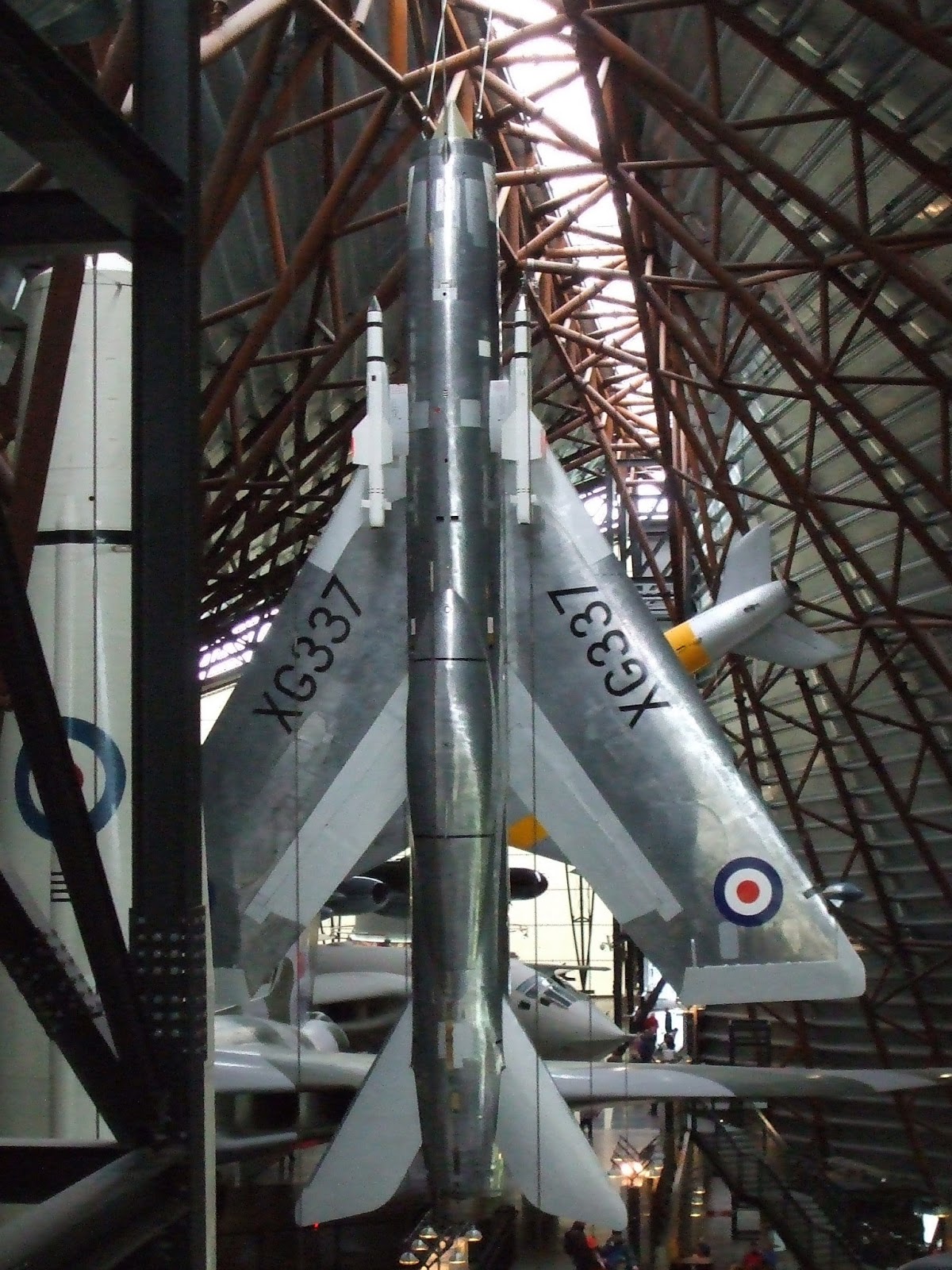
There is a truly massive hangar housing the 'Cold War' collection, and all the space is needed, because it houses examples of all three V Bombers, the Valiant, Victor and Vulcan, in addition to many other planes and armoured vehicles.  Unfortunately it is difficult to get a clear view of some of the planes, especially the ones suspended high up near the roof.  The English Electric Lightening is displayed vertically.

The fourth hangar, "Hangar 1" has examples of transport aircraft and also rockets, including the V1 and V2, plus the radio controlled Fritz-X.

So, if you are travelling near Telford and you have the time, the RAF Museum is well worth the visit.  There is a charge for parking, but entry to the museum is free.


Sunday, 26 May 2013

Recruits

With the Napoleonic game at Gauntlet due in early July, I have taken the opportunity to paint up some Prussian units.  Six battalions have joined the ranks, including some Guards, which will come in useful for the Leipzig scenario.


There have also been some recruits to the 17th century Polish cavalry,  two units of pancerni,  and they now have a commander.


All the flags are homemade, based on  designs from a Polish heraldry site.


Sunday, 19 May 2013

Triples 2013

Once more we ventured across the Pennines in search of wargames shows; the venue this time was Triples in Sheffield.  No Lance and Longbow game this year, so I had ample time to wander around the show to look at the games and trade stands.  The shopping list was fairly short as I had pre-ordered some medieval 'bits and pieces' from Essex, (many thanks for the excellent service, chaps).  These will aid the completion of the armies for the Deepdale game in June.  I also purchased some 15mm command figures to make up some more divisional command stands for the Napoleonic game at Gauntlet in July.


There was a strong Napoleonic emphasis amongst the demonstration games with a Peninsular skirmish, Ostrowono, Gross Beeren and Lutzen all making an appearance.   Gross Beeren was put on by the  'Like a Stone Wall' group;  who like most participants were happy to suspend the game to chat about the figures and rule mechanisms they used.


Lutzen was a 15mm game using the Age of Eagles rules put on by the 'Company of Veterans'.  Again they were happy to chat about the rules and their preference for that particular set over 'Shako'.


The Ilkley Lads had a very nice Cerignola game, with impressive scenery and Swiss pike blocks.


There was also an excellent 'Sudan' game with a railway train and steamer.


However, the game that really captured the imagination was 'Funny Little Wars' by the Mirfield Rifle Volunteers in aid of the British Legion.  This used 54mm figures in the tradition of H G Wells and even had participants firing cotton buds (matchsticks were a little too dangerous for the figures) from the field guns, any figures knocked down by the buds were casualties.  Edwardian costume and period German helmets completed the effect.


Monday, 13 May 2013

White Plains part 2

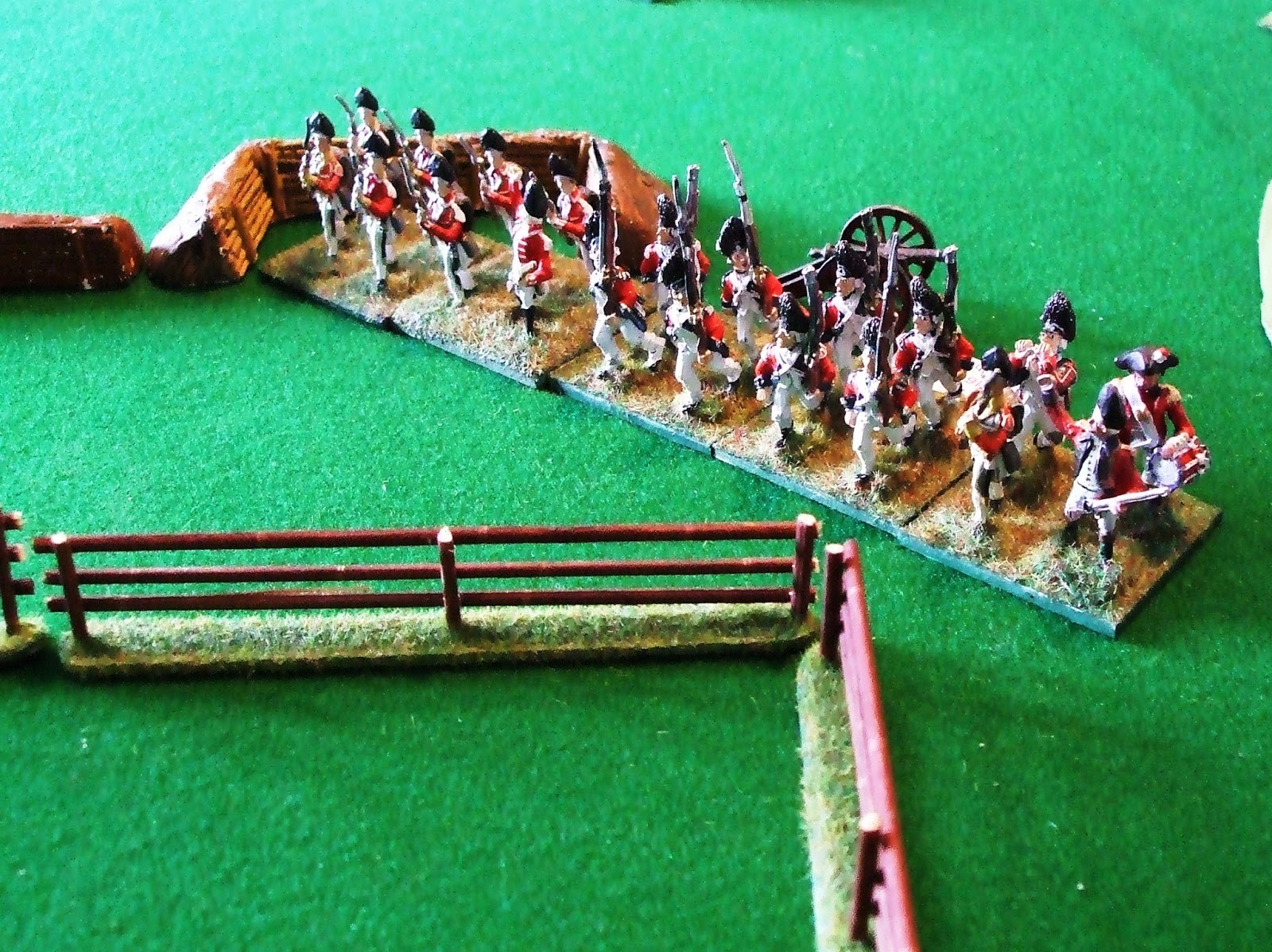
The attack on Chatterton's Hill now began in earnest.  The brigade holding the position had been weakened by sending one battalion down to cover the retreat of the militia brigade.  Encouraged by the fire of the British skirmishers this battalion had been swept up in the retreat of the militia and had sought refuge in the woods behind the hill.  The skirmishers followed the retreating Americans and the line battalions now concentrated on assaulting the hill.  The lack of a wall on the American right flank now caused problems.  The Americans had had no problem with British fire from  the front, but now they were also subjected to volleys from the flank.  With no protection from this direction losses began to rise.  Seeing the wall of bayonets advancing towards them the morale of the right hand American battalion broke and they too sought the protection of the woods behind the hill.


Fortunately for the American brigadier there was a transverse wall on the hill and he redeployed one of his two remaining battalions to line this in preparation for the expected British advance.

In the centre Clinton was slowly assembling his battalions ready to attack the right flank of the American position in White Plains.  He was hampered by fire from the American artillery and also the fire of the American defenders. He was constantly employed rallying his troops as they fell back under the American volleys.  However, he had positioned his cavalry on the road, ready to exploit any shakiness in the opposition line.  To his right, Archer's brigade was exerting real pressure on the American position. The Hessian fusiliers had now crossed the works driving off the militia who attempted to attack them, began firing on the defenders of White Plains.   Their supports were now crossing the works and the artillery was moving at its best speed towards that flank.


Brown's battalions crested the brow of Chatterton's Hill and were met by a volley from the defenders. Undaunted they stopped, fired a volley and continued their advance.  The right flank battalions of Brown's brigade now advanced and began to fire at the battalion lining the wall.  Flinching from this flanking fire and eyeing the advancing bayonets the Americans decided it was time to take to the woods as their comrades had done and soon all resistance on the hill ceased.

Howe sensed that a major victory may be within his grasp; with luck he could 'net' a substantial part of the American force if Brown cut the road behind White Plains.  However, Clinton's men were almost 'played out'.  Their advance had slowed as officer casualties mounted and they were passed by Brown's grenadiers who swept forward towards the American held works.  A volley from the grenadiers drove off the artillerymen who were attempting to withdraw their guns and a second forced the battalion holding the works to withdraw.  As the red line of grenadiers flowed into the American position there seemed to be no opponents left to dispute possession of White Plains.


Brown's success had not been duplicated by Archer.  He had seemed to be on the brink of victory as his fusiliers moved against White Plains; but the American commander called upon his last reserves to oppose him.  The fusiliers were stopped and then driven back by volleys from a militia unit.  The supporting battalion was fired on before it could deploy and had to fall back to reform. A third battalion was also stopped in its tracks by accurate fire from the defenders.  Suddenly the pressure on the Americans eased and, taking the opportunity the order to retreat was given.  The British pincers failed to close and so  the Americans were able to slip away.  On the road Clinton's cavalry commander fumed as the order came to hold his position.  Surely, now was the time for the cavalry to advance and turn retreat into rout.    


Clinton explained to Howe that is brigade was in no shape to advance and Howe confirmed the order to halt. 

Although the British had carried the position two of their three brigades required time to reorganise. For the Americans Two brigades has been driven from the field and a third was in a bad way; Washington felt fortunate that he was able to withdraw unhindered.

Sunday, 5 May 2013

White Plains 1776

This is one of the early battles of the AWI and there is an account of the action and a sketch map on the British Battles website.  Historically the attack on Chatterton's Hill encouraged an American withdrawal before the main British force under Howe could come into action.  Our scenario envisaged a co-ordinated attack using Howe's main force.

The four American brigades were deployed as follows, two in White Plains, one on Chatterton's Hill and  the fourth, a small militia brigade, in front of the hill to delay the anticipated British attack.  As usual, we used the Patriots and Loyalists rules.  The British were in three brigades.  Brown's, the largest was on the left, tasked with capturing Chatterton's Hill.  Clinton's small brigade was in the centre and would render assistance where required.  Archer's Brigade was to occupy the attention of the Americans in White Plains and  then pin them in place whilst Brown and Clinton moved on their flank.

The American Position


The American militia did their job well.  Two of Brown's battalions were driven back by enemy volleys and it was only once Clinton's men had secured some fields on the militia's flank that they were forced back.  In the open the Americans suffered heavy casualties from British volleys and in spite of the valiant efforts of their brigadier they were forced to fall back and rally.  The Chatterton's Hill position looked very strong, but, the light infantry skirmishers noted that the  wall did not encircle it.

Chatterton's Hill
  Brown therefore began to move even further to his left to strike this open flank.  All these delays disjointed Howe's plan.  Archer was advancing at a steady pace, but even so he was exchanging volleys with the defenders of White Plains long before Brown and Clinton were in position. This absence of pressure from the centre enabled Washington to move units to threaten the flank of Archer's advance.


Archer's advance nears White Plains       
 The two units on the left of Archer's brigade now felt the full weight of volleys from front and flank plus the attentions of Washington's artillery.  They tried to stand their ground, but inevitably, they had to fall back to rally.  However, the right hand column, led by the Hessian fusiliers seemed to have a charmed life.  Advancing steadily, halting and firing volleys and then resuming the advance, they neared the barricades near White Plains.  The German's steady volleys drove off the American defenders and Washington's left flank seemed to be in peril.

This was where our first day's gaming came to a close.  The British had made progress on both flanks, but the American position was just about holding.  Would the British, having taken casualties, still have the strength to carry the hill and town?

Sunday, 28 April 2013

Deepdale 1315

No, this not the result of an early kick-off outside Preston North End's ground, but an episode from  early 14th century Lancashire.  Ill-feeling towards the de Holland's by other Lancashire families, had spilled over into open warfare.  The rebels had raided de Holland estates in southern Lancashire and then turned their attentions northwards.  Thomas, Earl of Lancaster had ordered the sheriff of Lancaster to assemble some of Lancster's own retinue,plus the posse comitatus and put down the rebellion.  The two forces met near Preston in early November 1315.

Very little is known of the battle apart from the result, which was a decisive victory for the Earl's men.  We are planning to put on this game at the Phalanx show at St Helens in June this year and therefore have begun some play testing with the WAB  rules,with the aim of getting used to them and also identifying any 'tweaks' which may be needed.

So, we assembled  a motley collection of medieval figures and tried out one of the historic alternatives, where a vanguard of the Earl's forces attacks the rebels before the main body arrives.  The contemporary accounts suggest that this vanguard was soundly beaten, but when the main body appeared, the rebels were quickly routed.  The vanguard, although outnumbered, had a greater percentage of mounted knights and overall the Earl's men were of better quality.

Some outstanding shooting by the raw rebel archers initially drove off the vanguard's crossbowmen and the two bodies of mounted knights crashed into each other. There then followed a prolonged melee in which neither side managed to inflict any casualties.  The rebels manoeuvred a second unit of knights into a position where they could charge the vanguard's flank. Against the odds, this charge not only made little impact, but the vanguard inflicted sufficient casualties to rout their opponents.  After further rounds of ineffectual 'hacking and slashing' we decreed that both units of knights would fallback to reform.


The main body of the Earl's army now arrived and found the rebel forces somewhat disorganised.  A second body of knights charged a unit of rebel peasants.  As the peasants feared any formed enemy they had to take a panic test, which they failed.  As a result they rolled three d6 to see how far they would flee.  The knights had begun their charge from 12 inches away, so any total of 5 or more would save the peasants, they rolled three ones and were cut down.


This event set the precedent for some rather eccentric die rolling which resulted in over half the Earl's force heading for the baseline as they failed tests.  By the end of the battle each side had two units of infantry left and the rebels were deemed to have won, simply by not being driven from the field.


In the post battle review we decided that the units would have to be larger, not only to increase the chance of inflicting casualties, but also to stand up to losses better.  The saving throws also seemed rather generous for the knights (only being killed if a 1 was rolled).  So it is back to the drawing board to see what alterations we can develop to make things less of a lottery.

Monday, 22 April 2013

Kulm: Day 2

My apologies for the delay in completing the report on the Kulm scenario. Refighting day two took two sessions and family holidays intervened.  The last post closed with Vandammme's attack thwarted by the arrival of Russian reinforcements.  Overnight, he too received reinforcements and confident in the imminent arrival of St Cyr and/or Mortier resolved to stand on the defensive, pending their arrival.  The two divisions which had fought so hard, Revest and Dupas, were pulled back to act as the reserve and took up their positions in and around Kulm.  Philippon now held the right flank facing Straden with Dumonceau in the centre astride the high ground on the road between Kulm and Priesten.  Corbineau held the left flank facing Karwitz; to his right stood the light cavalry of Gorbrecht.  Chastel's light cavalry were positioned near Kulm to assist Philippon or Dumonceau.  Vandamme had called forward all his artillery to strengthen the line, a decision  which would pay dividends as the day progressed.


Osterman had also received further reinforcements.  On his left, near traden were the grenadiers of Rubin's division, supported by Rosen's guardsmen and Schavitch's cavalry.  Schachafskoi's division was between Straden and Priesten with Pischnitsky's men in support.  Between Priesten and Karwitz stood Mesenzov with Pahlen's light cavalry astride the Tepltz road.  Further back Osterman had two small cuirassier divisions (Duka and Kretov). Schwarzenberg had promised Austrian troops and they were expected to arrive to the right of Karwitz. Berg's division and the reserve artillery would arrive from Teplitz once the confusion of the retreat through the mountains was sorted out.  The allied plan was simplicity itself; a pinning attack against the french centre (Dumonceau), whilst Rubin and Mesenzov moved around his flanks to capture Kulm.  The Austrians, with Pahlen and Kretov's cavalry would move round the French left and cut the road behind Kulm, enveloping Vandamme's forces.


The Austrian troops were delayed, but Osterman decided to attack anyway and after a brief bombardment the Russian infantry moved forward.  Beyond Straden the grenadiers crossed the stream and began their advance towards Philippon's troops.  Their columns came under concentrated artillery fire and as they deployed into line they masked their own guns giving some relief to the French infantry.  In the centre, Schachafskoi's men also suffered from the French artillery, it seemed that every ball caused casualties; before they had reached the stream the front line battalions had suffered 50% casualties and the second line moved through to take up the advance.  On the heights, Dumonceau's front line was suffering, but his second line, behind the crest was virtually intact.  As Mesenzov's men moved forward seeking Dumonceau's flank, Vandamme ordered Dupas' division to' plug the gap'.  Also, seeing the chance of restricting the allied cavalry, he ordered Corbineau to seize Karwitz.


Pahlen's men were moving to the right of Karwitz and Gorbrecht could hold them in check, but not if the Russian cavalry reserve intervened.  After initial skirmishing as the allied cavalry crossed the stream, the French seemed to be getting the upper hand and Ostermann sent an aide with orders for Kretov's cuirassiers to support Pahlen.  However, in the nick of time, the Austrians, led by Nostitz's cavalry entered the fray.  The extra numbers forced Gorbrecht to fall back, but allied progress was slowed by the lack of space to deploy, the stream and the attentions of French artillery on the hill between Kulm and Karwitz..

On the Allied left the attack by the Russian grenadiers had stalled.  Philippon had pulled back most of his infantry to the shelter of the hill and his artillery was doing all the damage.  Rubin was struggling to hold his division together as the casualties mounted.  Vandamme saw an opportunity to further disrupt the Allied plans and ordered Chastel to advance to threaten the flank of the grenadiers.  As the light cavalry moved forward they came within range of the Russian guns and paid the price, particularly the 3rd Chasseurs, who were the lead unit.  This small success was totally overshadowed by the fate of Schachafskoi's division.  Already weakened by losses following the battle of Dresden and subjected to artillery fire on their advance the Russian battalions melted away as they came within canister range.  The hillside below Dumonceau's troops was carpeted by Russian dead.  It was too much and the Russian infantry began to fall back.  The division took no further part in the battle, taking the task of garrison of Priesten.  To cover Schachafskoi, Osterman ordered Pischnitsky to advance and attack the ridge to the right of the road.  This would also support Mesenzov who was making slow progress now that Dupas' men had come into the line.  


Karwitz had become the prize in a race between Hessen Homburg's Austrians and Corbineau's Frenchmen.  Fortunately for the Allies the Austrians won.  The men of 1st battalion Weidenfeld had barely taken up their position within the village before the first French attack was launched. Their volley stopped the men of the 23rd Ligne in their tracks and they fell back to regroup.


As he surveyed the field, Vandamme could feel reasonably satisfied; most of the allied attacks had stalled, their centre was being bled white by his artillery, only on his left was there any concern and for the moment Gorbrecht was keeping the Allied cavalry boxed in.  However, his thoughts were rudely interrupted by the arrival of a dusty and dishevelled courier.  "The Prussians are here!" he reported.  "They are blocking the Pirna road and coming this way!".  "Where the ***l are St Cyr and Mortier" shouted Vandamme, "they are supposed to be supporting me".  He surveyed the field again.  To his front more Russians were approaching from Teplitz, to the right were the wooded heights and mountains and to the left masses of enemy cavalry.  The only option was to try and breakout through the Prussians.  Aides were sent with orders to Dupas and Corbineau to break off action and retire on Kulm.  Gorbrecht and Chastel would have to do what they could to aid Dumonceau and Phillipon holding the line whilst Revest, Dupas and Corbineau dealt with the Prussians.

Osterman was becoming increasingly concerned by his losses and welcomed the sight of Berg's division advancing with the reserve artillery.  Schavitch was ordered forward to help Rosen's guardsmen against Chastel and space was cleared for the deployment of the artillery reserve.  Then an aide pointed out that Mesensov's men seemed to be falling back.  There was no mistake, Mesensov's division had broken and was retreating between Priesten and Karwitz leaving Pischnitsky's division isolated.  On the French side Dupas was savouring the moment.  A large gap had now opened in the Russian line, victory was still within their grasp.  Then an aide arrived with fresh orders.  Dupas read them with disbelief "we've got the b*****s on the run! what does he mean, retreat?"  The aide took him to one side and queitlyexplained about the Prussians.  With a heavy heart Dupas gave the order and his division began to pull back.

On the Russian left Rubin's grenadiers were a spent force.  Only small groups remained with the colours as men were scythed down by artillery fire.  Then Chastel's troopers charged.  Squares were formed and the cavalry beaten off, but a more severe test needed to be faced.  The survivors were now lashed with canister.  The squares shrank, but endured.  Chastel charged again and the grenadiers were swept away.  However, any pursuit was brought up short by the solid ranks of Rosen's guardsmen and their supporting artillery.  

Pischnitsky's division continued to attack Dumonceau.  Showing great determination they reached the crest of the ridge and pushed back the first line.  Their success was their undoing, as with both flanks in the air they were almost enveloped by the counter attack and tumbled back down the slope and across the stream.  Officers struggled to restore order and the division played no further part in the battle.  Dumonceau was now coming under increasing pressure as the Russian artillery reserve came into position and began to bombard his position.  His right was threatened by two of Rosen's guards battalions and Schavitch, who was now taking up position to oppose Chastel.  The latter ordered the lancers to charge the leading guards battalion.  They caught it before it could form square and destroyed it.  Their blood up, the Frenchmen carried the charge towards the supporting guards unit, Preobrazhenski.  This also failed to form square, but the veterans took on the  lancers and drove them off.


Now was the time for Schavitch to strike, but one of his units charged the guns on the hill.  Like so many other frontal attacks on artillery this resulted in a bloody failure, with the remnants of the unit routing back across the stream.  Seeing the rout the other two units of cavalry also fell back, leaving Rosen's flank open again.

However, on the allied right affairs were progressing more satisfactorily.  Nostitz had eventually managed to push Gorbrecht's men back, making room for Pahlen and Kretov to swing to their left and threaten the flank of Corbineau's division.  Three more attacks had been made on Karwitz, each one with determination, but each repulsed by Weidenfeld.  The flank was covered by the 8th legere, but the presence of Pahlens cavalry forced them into square.  They now became a target for Pahlen's horse artillery and suffered accordingly.  Corbineau's own artillery was placed on the high ground beyond Karwitz and it swept the ground over which Pahlen and Kretov would have to advance.  A unit of Uhlans had managed to work their way round to the rear of the hill, brushing aside light infantry in the process and in a combined charge with the Kaiser Cuirassier regiment they put the artillerymen to the sword.  It was about this time that Vandamme's aide reached Corbineau with the order to fall back.  "How am I supposed to do that?" he asked, pointing to the cavalry on his flank and the masses of Austrian infantry pressing forward. 


We drew matters to a close at this point.  Vandamme's left was lost, but three divisions, (Dupas, Revest and Phillipon) could have tried to break through the Prussians.  Dumonceau would have had to do what he could to hold off any pursuit.  The Russians were a spent force.  Four of their infantry divisions were badly mauled and would be out of action for some time.

The Shako rules again proved their worth.  The command element was particularly useful on this occasion, with the aides carrying orders, which when they arrived did not always take account of the changed circumstances.