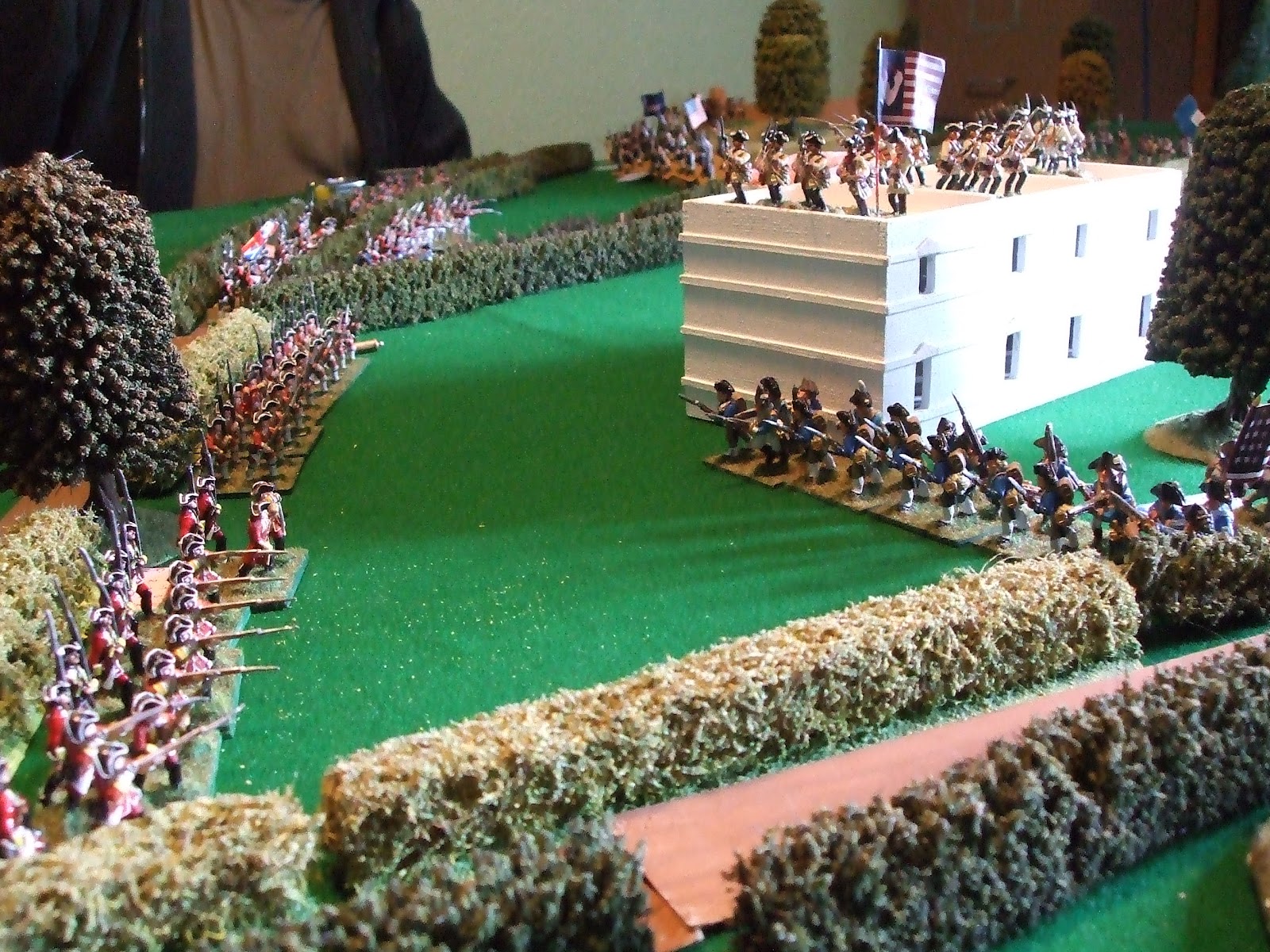
Friday, 13 July 2012

Kagul continued

After two nights of gaming and the defeat of the Ottoman cavalry and infantry attacks, I thought that the difficult part of the battle was over.  However, there was still a force facing the Russian squares and the Janissaries manned the ramparts of the Ottoman camp.  On my left the Tartars were still flowing around the squares.  The Cossacks there had reformed and I was tempted into a counter attack.  I managed to conjure up a flank attack on one Tartar unit and beyond that was another which was vulnerable to a flank attack.


As often happens these 'castles in the air' disappeared when the dice return you to reality.  Against the odds my Cossacks were defeated and driven from the field.  This left the squares with no support and they were harried by archery.  Two more squares succumbed to the fire, breaking and running for the sanctuary of the Russian camp.


Meanwhile I had more pressing matters to concern me.  The Ottoman infantry attacked again.  Ignoring their casualties, they closed to melee the front face of the reformed square.  It was a tough fight, the Ottomans, supposedly lower grade fighting men, more than held their own, even against my grenadiers.  Eventually, the Ottoman losses forced them to fall back and then they were charged in the flank by the Russian heavy cavalry.  This proved too much and the remnants ran for the camp.


This seemed like the opportunity to advance with the whole force and attack the Ottoman camp, but those d*mned Tartars intervened again.  Seeing that the Russian attack on the Tartar camp had been defeated before it started, the remaining Tartar units swung to their left to harry the main Russian squares.  These were vulnerable because the bulk of the cavalry had moved to the right to see off the remaining Ottoman cavalry.  Quickly the reserve cavalry, a unit of dragoons, moved to the Russian left to link up with the remaining horse grenadiers.  The Cuirassiers, who had driven off the Ottoman infantry, had to turn about to cover the flank of the Russian centre.  Matters were not helped by one of my cavalry units going into an uncontrolled pursuit and disappearing towards the Ottoman baseline.

So, after three hours action, the main Russian force had manged to advance about 6 inches, had suffered casualties from the Ottoman infantry and artillery and now had it's flank threatened by the Tartars.  Hopefully, the fourth evenings action will see the Russians take on the Janissaries, though there is a lot of work to do before that happens.     

Tuesday, 10 July 2012

Borodino

This last weekend a sub-committee of the Gentlemen Pensioners put on a Borodino game at the Gauntlet Games Weekend organised by the Deeside Defenders .  We used the 'Large Battles' version of the Shako rules (the original edition, not Shako II) with a few alterations.  The troops were deployed in roughly their historical locations, although some adjustments had to be made to fit the terrain onto the 12 x 6 table.


Originally the orbats were drawn up on the basis of having three 'wing' commanders per side plus the 'army' general (ie Napoleon and Kutusov).  On the day, we were looking at only two per side, but were rescued by three passing volunteers who, although new to the rules joined in 'to see how it works' and enjoyed it enough to come back on the Sunday.  Many thanks to Gary, John and Martin for stepping into the breach.
Because of the scale of the game (manouevre elements are divisions), the attack by Eugene on Borodino village was decided by die rolls.  The result was that the French achieved complete surprise in their attack and thus captured the bridge over the Kolocha river intact.  This proved to be somewhat of a mixed blessing because Eugene sent Broussier's divison over the bridge and up towards the Raevsky redoubt. Unsupported, Broussier became the target for several Russian batteries and although he charged Olsufiev's division he was driven back down the hill, so heavily damaged that the division took no further part in the battle.


Davout had started his advance on the Bagration Fleches which were held by Vorontsov's division.  Morand and Friant moved forward quickly and although the Russians fought bravely, numbers told and the Fleches were soon in French hands.  Bagration had sent forward Neverovsky's division in support, but their counter-attack failed and they too had to fall back and regroup.  With Ney's corps also moving forward on Davout's left, Bagration sent an aide post haste to Kutusov requesting reinforcements.


Poniatowski's corps had begun to advance on Utitsa, but Tuchkov's corps was waiting for them and had the greater weight of artillery.  A stalemate developed with neither general able to gain an advantage.

Just as the French seemed to be strolling to victory the Russian flanking attack by Uvarov and Platov appeared on Eugene's flank.  Dornano's light cavalry tried to hold back the Russian dragoons but they were overwhelmed and a flanking attack by Triari's Italian dragoons on Uvarov failed.  With his cavalry falling back to recover, Eugene requested support from Napoleon.  The III Reserve Cavalry Corps was sent to Eugene, but with specific orders that it was not to be committed to anything other than countering enemy attacks.  With the Italian infantry in squares to hold off the Russian cavalry, the Italian artillery did its best to subdue the Russian guns, particularly those of Barclay's Corps which were inflicting heavy casualties.  To try and relieve the pressure Eugene sent the division of Compans forward against the Raevsky redoubt.  Again unsupported, the attack was driven back by heavy losses.

On the Russian left Bagration's last reserve, Mecklenburg's Grenadier division provided a rock around which Neverovsky and Voronstov's infantry could rally. Siever's dragoons moved to the left flank threatening to drive off Davout's corps cavalry.  More in hope than certainty Davout's hussars charged the Russians and against the odds, prevailed.  To counterbalance this setback Vorontsov's division pushed back Friant and Mecklennburg's grenadiers pushed back Morand, in addition Osterman-Tolstoy's Corps arrived giving Bagration two fresh infantry divisions.

That is where the action drew to a close on the Saturday afternoon.  On the restart on Sunday morning Kutusov and Napoleon issued orders to their 'wing' commanders. Bagration was 'requested' to retake the fleches as he pondered how he was to achieve this, Davout's infantry advanced again to support Ney.  Davout had been reinforced by St Germaine's cuirassier division and given orders to clear the enemy in front of him and then move north towards Gorki.  In the ensuing melee, Mecklenburg's grenadiers pushed back Friant, but Vorontsov was overwhelmed by St Germaine's cuirassiers before they could form square.

Ney's orders were that he should cross the Semeyonovskii stream and secure the ridge beyond.  To assist him he had been allocated the IV Reserve Cavalry Corps and the Reserve Artillery (3 12lb Batteries).  With his usual elan Ney advanced confident he would seize the ridge.

On the far right of the French army Poniatowski had received a rather curt order from Napoleon enquiring why he had not captured Utitsa.  Fulfilling his orders Poniatowski advanced but in doing so triggered a flank attack by Tuchkov's cossacks who had been put in the woods for such an eventuality.  Krasinski's men found themselves attacked frontally by Konovnitsyn and threatened by the cossacks to their left rear.  Pulling back his artillery, Poniatowski launched Kaminski's and Bruyere's light cavalry at the cossacks.  Outfoxed by their more agile opponents the French cavalry fared badly, but in the end both sides had to pause to recover.  Konovnitsyn had by now charged Krasinski's troops and had driven them back.  The advantage now lay with the Russians.

On the opposite flank Eugene was pulling back his Italian infantry to protect Borodino and the guns which were firing at Barclay's Corps which protected the right flank of the Raevsky redoubt.  He sent Compans and Dessaix's divisions forward in a frontal attack against the Redoubt, supported by Grouchy's dragoons.  Although artillery had been bombarding the redoubt throughout the battle its fire was not slackening and the attackers suffered heavy losses in their advance.  Compans was repulsed by Vasilchikov's division and Dessiax never even reached the Russian line, heavy losses forced him to retreat and take no further part in the battle.  However, Dessaix's unsuccessful attack had allowed Grouchy to approach unmolested and he led his men forward against the Russians.  In a fierce melee the cavalry prevailed and forced Olusiev's division to fall back.  A foothold had been gained on the hill, but there was no infantry available to hold the ground, so Grouchy fell back to reform.

In the centre the struggle between Bagration and Davout continued with one and then the other moving forward.  Bagration's hand was strengthened by the arrival of the last Russian reserves, the Guard infantry and cavalry divisions.  Their presence helped to sustain the wavering ranks of Mecklenburg's grenadiers.  Ney was by now locked in battle with Osterman-Tolstoy and found himself outnumbered.  His cavalry had been driven back and now his infantry were having to form square right under the muzzles of the Russian guns.  The cavalry divisions of Mourier, Lorge and Rozniecki seemed unable to reorganise after their defeat and while they dithered, the infantry suffered.

At Utitsa the Russian advance began.  Poniatowski had tried to buy time by ordering Bruyeres light cavalry to charge Marov's Militia, but the horsemen had been driven back by the Russian artillery.  Kniaziewicz's infantry division found itself attacked by both Konovnitsyn's infantry and Strogonov's grenadiers.  A fierce melee developed with little quarter but the Polish spirit won through and both Russian divisions fell back.  After this the fighting died down as both sides fell back to their initial positions and maintained an artillery duel.

Behind the Raevsky redoubt Dokhturov had been ordered to take his corps forward to reinforce the troops supporting the redoubt.  It was as well he did because the troops of Barclay and Raevsky were nearing the end of their strength.  They had endured artillery bombardment, infantry attacks and cavalry attacks throughout the battle and another attack was being launched.  Defrance's heavy cavalry division, supported by Pajol's light cavalry surged up the slope towards Vasilchikov's infantry.  Now hit by fire from the reserve artillery brought forward by Ney the Russians were swept from the ridge.  At the same time Grouchy charged Dokhturov's divisions.  One held, but the other was driven back.  Again, the ridge was in French hands, but Junot's infantry were too far back and the French  cavalry had to fall back again.

It was at this point the battle ended.  the corps of Davout and Ney had been stopped by Bagration and Davout's troops in particular were close to exhaustion.  At Utitsa no progress had been made, the position around the redoubt was uncertain.  A draw was declared, which was for the French a strategic defeat.  The Russian army had not been heavily defeated and losses had been high amongst the French infantry divisions.  Napoleon had kept his Guard fresh whilst the Russians had been forced to commit all their reserves.

The French committed troops with a total breakpoint of 143 and lost 82 points, 55 of those in the troops of Eugene and Davout. The Russians committed 162 points and lost 66.  Of these 27 (out of 40) fell on Bagration's original command.

This was an excellent weekend.  Many thanks to the Deeside Defenders for providing an excellent venue and refreshments.  If you have the chance, drop in at next year's show.  I close with especial thanks to the Gentlemen Pensioners (Alasdair, John, Roy and Steve) plus the 'volunteers' Gary, John and Martin who contributed so much to making the game so enjoyable.  Many thanks chaps!

I will post more photos in the gallery over the next few days including some supplied by John which give more of an overview of the battle.


Wednesday, 4 July 2012

Battle of Kagul 1770

This was one of the major battles of the Russo-Turkish War 1768-1774.  It was also one of the largest battles of the century; with estimates of up to 180,000 combatants, c40,000 Russians, 70,000 Ottomans and a similar number of Tartar allies.  The battle is not well known but here  is a link to a report on a refight in 15mm by Black Wolf Wargames.


We divided the battle into three stages, an attack by the Ottoman cavalry, followed by an attack by Ottoman infantry and then (hopefully), an advance by the Russians on the Ottoman camp.  The Russian force was deployed in four divisional squares, each with cavalry supporting them from the rear.  Each square had integral artillery and a small reserve to fill any gaps appearing in the ranks.


I took the part of the Russian commander Rumyantsev and tried to appear unconcerned as hordes of cavalry swept down on the squares.  The square on the far right occupied by Rumyantsev himself, acquitted itself well.  The artillery causing heavy casualties amongst the horsemen and then the infantry standing to deliver volleys at close range.  Those determined Ottomans who reached the Russian infantry were unable to make any impression on the squares. 

 Gauging the moment had arrived to counter attack, I ordered the unit of Horse grenadiers to clear the remaining cavalry away.  This was an error.  The Horse Grenadiers advanced, their flank covered by Hussars.  However, the Hussars were no match for the Spahis, who quickly swept them from the field.  Quickly the Ottoman cavalry reformed and attacked the rear of the Horse Grenadiers.  These could not respond to the threat because they were busy fighting the cavalry to their front.  In no time at all my largest cavalry unit was a broken mass of fugitives seeking shelter off the field. Fortunately the Ottoman attack on the neighbouring square had also been repulsed and this allowed me to move more cavalry over to cover my flank.


Meanwhile,  the square on the far left had been ordered to advance on the Tartar camp and disperse the light cavalry.  I had not appreciated just how many Tartar cavalry there were and soon they were swirling around the square, pushing back the Cossack cavalry protecting the flanks.  Whilst the heavy cavalry had had real difficulty making any progress against the squares, luck favoured the Tartars.  Their continual archery must have unsettled the infantry because when charged one of the battalions broke.  This of course created a gap, which was exploited ruthlessly. The light horsemen poured into the square, pursuing the fleeing infantry and attacking the hastily assembled reserve.  This was cut to pieces and the general commanding the square was lost trying to assemble a new defence line.  The individual colonels took matters into their own hand and ordered their battalions to form square. Most managed it, but all divisional cohesion was lost, along with the artillery and two battalions of infantry.
On the Russian left the battle was now a stalemate with the Russians unable to advance and the Tartars contenting themselves with shooting at the immobile infantry.

The main Ottoman cavalry attack had been all but driven off, but it had allowed time for the infantry to advance.  Rumyantsev was again fortunate that the infantry attacking his square were low grade militia who could be driven off by artillery.  The smaller square to his left was not so lucky, they were facing Solaks.  Undaunted by the infantry volleys the Ottomans charged home and after a stiff struggle broke through into the square.  The rear of the square about-faced and fired a volley which cut down many of the Ottomans, but they still fought on, causing yet more casualties before they were finally wiped out.  The square to the left of the one attacked by the Solaks was attacked by the last Spahi unit and this was successful.  The Ottomans destroyed the unit they faced and then carried on to attack the one at the rear of the square, this too was dispersed, but the Ottomans were then charged by the supporting cuirassiers who wiped them out.


The remnants of the two damaged squares were amalgamated, so now two Russian squares would advance on the Ottoman camp.  The cavalry would be fully occupied in protecting the flanks  against attack by the remnants of the Ottoman cavalry.

I hope to report on the third stage of the battle next week.  

Friday, 22 June 2012

Germantown 1777

The second part of last weekend's wargames activities was the AGM of the Gentleman Pensioners on the Sunday.  Steve, our host, had set up the battle of Germantown and I was allocated one of the four  columns making up the American attack.  Historically, foggy conditions had made the co-ordination of the attack difficult and the confusion transferred itself across the years and into the wargames room as two of the trays holding the troops were mixed up and the artillery appeared on a different road to that intended!  A view from the British perspective can be found on Will McNally's AWI blog
Here is a link to a map of the action.  To further represent the difficulties of a night march the column commanders had to roll a dice to see if they had arrived on the field, two did, but two, including my column were delayed.


Dave commanding the column on the far right was soon in action, his rifles starting a firefight with a flank guard of Hessian jaegers.  Eventually the Hessians pulled back, but they had delayed the American column and given chance for the rest of Roy's command to form a defence line.  However, the dice had now decided that my troops could now enter the fray and from that moment on my knowledge of what was happening outside the range of my artillery is rather sketchy.

To my right Ian's column was making good progress down the road, but on hearing firing to his right he began to move in that direction, towards Chew House.  This strongpoint was ignored by Roy, who pulled back his light infantry towards Germantown, consolidating his position there.  At the time this was thought to be a mistake, especially as Dave's troops were by now making a determined attack on  Roy's left flank.

Leading my column were the cavalry, who quickly out distanced the infantry, ignored some flanking fire from British light infantry and galloped towards Germantown.  The riflemen, moved off the road to oppose the British troops who after firing another volley fell back towards the town.  This cleared the way for my artillery to take up its position on a low hill and begin firing at the British troops defending Germantown.  Roy had had difficulty getting his command organised (he was plagued by low dice rolls) but eventually a strong defensive position was established.  This was just as well for Chris's main column (with the elusive artillery) had now arrived and so all four American columns were bearing down on the British position.


My rifles were now lining a hedge with a clear view of the British defenders and my infantry battalions were deploying from the road to attack  the British right.  The cavalry thought that there was a chance to charge one of the British battalions in the open.  However, as they formed up to charge they were hit by a volley from the British infantry and before they could recover from that a second volley sent them tumbling back in a rout.

To my right Ian was trying to dislodge the British Light Companies from a hedge line and Chris was firing on the troops holding the church.  On the far right Dave was making valiant attempts to capture some of the Germantown buildings.


Roy had been casting anxious glances over his shoulder looking for reinforcements arriving and at last his prayers were answered.  Phil and Will arrived with their columns of reinforcements, one on each flank.  Part of Phil's infantry  deployed to face my battalions, but the grenadiers carried on up the road towards Ian's men.  Ahead of the grenadiers were the light dragoons.  They seemed to have a charmed life, passing through infantry and artillery fire without suffering any losses and moving quickly along the road to their front,  they were soon in the rear of the American position.

The grenadiers were not so lucky.  My riflemen did not miss when firing at them.  Several officers were hit and in confusion the grenadiers routed.  Success was brief however,  The American militia battalions could not face up to the British line in the open and, in what seemed like the blink of an eye, all three were routing back down the Limekiln Road.

Ian was also sustaining heavy losses.  His battalions had been unable to push back the Light Companies and two others had failed to stand when charged by the British troops.  He quickly established a second line of defence around the strongpoint of Chew House.


Chris had been holding his own against the Germantown defences, but the gun he had pushed forward to bolster the attack  had been abandoned by its crew when they were fired upon and seeing Ian pulling back, he too fell back.  Dave too had been forced onto the defensive due to heavy losses and the reinforcements from Will's column.

For me, total defeat was only a few moves away.  Phil's cavalry had moved round behind me.  I attempted to hold them off with my cavalry, but that failed, with my troops being swept away.  Phil's men then totally destroyed two of Ian's touting battalions and for 'afters' overran my battery.  On Limekiln Road one of my battalions had managed to rally to cover the rout of the rest and my riflemen were trying to hold back two advancing British battalions.  Inevitably, the rifles routed when charged and the militia pinned to their front by infantry volleys and attacked in flank also routed.  My command figure, wounded in the final British attack was captured by the all-conquering British Light Dragoons.

The troops around Chew House could see that both flanks were now 'in the air' and that they faced being trapped, so they too joined the general retreat and the action ended with a British victory.

Many thanks to Steve for umpiring the game and the 'Pensioners' for their good company. 


Wednesday, 20 June 2012

Phalanx 2012

The first part of a busy wargames weekend was a visit to the Phalanx show put on by the Saint Helens Spartans, a good mix of traders and games and usually you can find a bargain on the bring and buy.  This year I was helping out on the Lance & Longbow Society stand with their Ravenna game.
The French attack on the Spanish camp is a bit of a slogging match, especially between the rival groups of gendarmes.  The melee swung back and forth, eventually being decided in the French favour.  My fellow French commander was also able to overpower the Spanish guns and then cross the earth bank with his pikemen. This decided the battle in our favour.


My part had been to try and gain entry to the camp via the other entrance.  The light cavalry had battled hard, but made little progress, mainly because they had beem impetuous enough to mask their own guns.
A close, hard fought game using home grown rules which had been developed for use in participation games and therefore easy to use.

One game which particularly caught my eye was a Seven Years War action involving an Austro-Russian attack on a Prussian convoy.  The game was put on by Corbridge Old Contemptibles using the Rank and File rule set.


There was also a game representing the battle of Wartenburg 1813 put on by Loughborough Wargames.  This battle has interested me for some time, sparked by a magazine article by Peter Hofschroer.  The main problem is getting the terrain, which is very constricting, right; in particular the dykes and marshy woodland.  The Prussians have masses of troops, but can they get them in place to attack?  General de Brigade rules were used, making for large units.


Expenditure was pretty low this year, some river sections from S & A Scenics and some paint from Fighting 15's, I thought I'd try the Coat D'Arms Horse Tone paints which I haven't seen before. 


Friday, 15 June 2012

Sundeved 1848


We are back with the Schleswig War this week with the action at Sundeved. The Danes had bided their time and waited for the German allies of Schleswig to pull back.  The Danes then crossed to the Sundeved peninsula and pushed forward, hoping to defeat the Schleswig defenders in detail, before the supports could come up. The Danes also hoped for some naval support from the Als Fjord.


Here is a general view of the battlefield with Dybbol Mill, the Danish objective, in the far distance.  The Danes need to capture the villages to ensure their lines of communication.  The main effort was made up the lefthand road, directly towards Dybbol, with a flanking manoeuvre up the righthand road.

At first good progress was made, the 2nd Schleswig jaegers were driven out of the first village along the lefthand road and the flanking force, with artillery support easily captured the village on the right.  There was no sight of sails in the fjord, but the main force pushed on towards Stenderup.  Their progress was halted by a charge of the Oldenburg Dragoons

Their charge caught the supporting Danish artillery unawares, their shots went wide, and overran a unit of jaegers.  They then hit the 4th Infantry Regiment before they could deploy and scattered them to the winds.  However, the Oldenburg horsemen were now isolated from the rest of the Schleswig forces and were charged by a regiment of Danish dragoons, this forced them to retire, but they had delayed the Danish attack long enough for the garrison of Stenderup to be reinforced.

Slowly, the main Danish force advanced.  By the fjord they faced 4 battalions of Schleswig infantry who carried out a model fighting retreat.  Firing a volley as the Danes came in range and then falling back forcing the enemy to advance again.  Danish infantry approached Stenderup, whose outer defences were held by a militia battalion.  They repulsed the first attack, but were forced to withdraw when flanked by jaegers and fired on at close range by artillery.  This left the 2nd Schleswig jaeger as the garrison of the village.  Eager to make amends for their earlier retreat they forced a second attack to retreat and seemed invulnerable to close range artillery fire.

The Schleswig cavalry again intervened; the Schleswig dragoons routing a unit of Danish dragoons who were covering the flank of the attack on Stenderup.  The Danes did not stop running until they were over the pontoon bridge.  Like the Oldenburg Dragoons, the Schleswig Dragoons now found themselves isolated and found themselves surrounded by Danish cavalry.  They tried to cut their way to freedom, but very few made it and the unit played no further part in the action.  However, the Danes now found themselves under fire and one unit routed, again not stopping until it crossed the pontoon bridges.  In front of Stenderup the 6th Danish Infantry had sustained such heavy losses from rifle and artillery fire that it had to retire from action.  Two further units also retreated due to losses from the fire of the Schleswig troops covering the area between the fjord and the road.

The Danish commander was beginning to think it was not going to be his day.  "Where was the d....d navy?  They had promised him support".  Unfortunately, contrary winds had kept the navy at its moorings and the army was going to have to fight this battle on its own.  At least the flank attack on the right was making progress.  A third attack on Stenderup was organised, with troops coming in from three sides.  Amazingly the Schleswig jaegers held on.  Schleswig artillery stopped the attack from the right and jaeger volleys halted the other two attacks.  However, ammunition was now running low and further Danish units were readying for a fourth attack; this one with artillery support.  Firing off their remaining ammunition the jaeger fought like demons, but were forced by weight of numbers to give ground. 


As they reached the now fully manned Schleswig defences they received well deserved cheers from their comrades.  

It was now late in the day and the Schleswig commander believed his men had done enough to halt the Danes.  The militia had fought well, making good use of the ground to slow the advance and the cavalry had suffered losses but bought the time necessary to form a defence line.  For the Danish commander all he could do was try and hold what ground he had captured.  Several of his units would take time to recover from their losses and the officers of those units which had routed would need to be replaced.

This was a classic action where the ground made it difficult to make full use of superior numbers


Sunday, 3 June 2012

Maltrovo

This week's battle is a fictional scenario set in Eastern Europe in the 17th century.  Relations between Muscovy and the Cossacks blew hot and cold and at this particular time Muscovy was looking to extend its 'influence' to the south and west.  The Cossacks, valuing their independence, opposed this and the scene was set for conflict.  The two armies met at the small town of Maltrovo.  Leading the Muscovites was Prince Dmitri Pozhorski.  He had five units of streltsy and three units of feudal cavalry; the latter being under the command of Prince Petyr Rostov.
In addition he had a unit of German mercenary foot commanded by Gottfreid von Allenstein. and a field gun. 

Commanding the Cossacks was Borotnikov.  His main line consisted of three infantry units; on the left the Sodomirz Cossacks, in the centre the Godisz Cossacks and on the right, next to Maltrovo,Borotnikov's own regiment.  Maltrovo had a garrison of the Przemsyl Cossacks and also a unit of mercenaries under Captain Mohrungen, all under the command of Borodavka.  The cossacks placed all their cavalry on their left flank, opposite the Muscovite cavalry.  They had one light gun in Maltrovo and a second in the infantry line.


Pozhorski decided on a general advance by his streltsy to engage the Cossack foot in musketry. Once the enemy foot were weakened, he would attack with his cavalry.  Although he outnumbered the enemy, Pozhorski found it difficult to deploy all his men to shoot and although he was inflicting casualties, he was not gaining the advantage he sought.  However he was helped by a decision by Minin, the Cossack cavalry commander.  Interpreting the inactivity of the Muscovite cavalry as a general reluctance to fight, Minin sent forward a screen of cavalry to fire arrows, hoping to drive the enemy away. His action had the opposite effect.  Stung into action by the Cossack arrows, two units of feudal cavalry surged forward.  They had the advantage of numbers and mail shirts, but the Cossacks managed to hold the initial charge.  Minin sent forward the supporting squadrons and managed to maintain his position on the far left, but on his right, is cavalry were routed.


Hoping to plug the gap he led forward his last reserve and for a time this restored the balance.  Fighting bravely in the front rank Minin was cut down and what remained of his men routed.


Rostov acted quickly to steady his men and prevent them from pursuing the fleeing enemy.  Although Minin had failed to stop the feudal cavalry, his brave charge had bought the time for the Sodomirz Cossacks to redeploy to meet the flank attack by the cavalry.  This redeployment reduced the fire on the Voronsov and Barneskya streltsy and enabled them to concentrate their volleys on the Godicz Cossacks.  Godicz also had to contend with the Muscovite field gun which was firing with deadly effect, shot taking out files of men.  With losses approaching 50% Borotnikov ordered the Godicz Cossacks to fall back and become part of the garrison of Maltrovo.

In the town, Borodavka watched events keenly and saw an opportunity to attack the left flank of the Muscovites, which had been weakened by the fire of Borotnikov's Cossacks.  He therefore led out the garrison hoping to reduce the pressure on the Cossack centre.


On the Cossack left Rostov had now reformed his cavalry and began his attack on the Cossack centre.  One unit of feudal cavalry charged the Sodomirz Cossacks and were repulsed with heavy loss.  A second was more fortunate, they caught the retiring Godicz Cossacks.  Initially the infantry managed to stand against the feudal cavalry, but as more joined in the melee numbers began to tell and despite their bravery the infantry routed. 


Undeterred, the Sodomirz Cossacks held their position daring the cavalry opposing them to charge again.  But Rostov realised that a charge was not necessary.  he brought forward the Vorontsov streltsy to fire on the flank of the Cossacks, causing heavy casualties.   Seeing the danger looming over his force, Borotnikov joined his own regiment and redeployed them to cover Maltrovo.  The Muscovite artillery now shifted its attention to this unit and whilst urging his men to stand firm, Borotnikov was almost cut in two by a cannonball.  His aides quickly removed the body, but the infantry were shaken by this turn of events.

Pozhorski moved forward the Barneskya streltsy to fire at the Boronitkov Cossacks and a unit of feudal cavalry moved forward ready to charge.  The position was hopeless and the Cossacks surrendered; the victory was Pozhorski's.

But what about Borodavka's flank attack?  Well the Przemsyl Cossacks had been engaged in a musketry duel with Allenstein's men and the Ivanov streltsy.  To their right Mohrungen's men had continued to advance and were on the point of attacking the Hadiach streltsy when news came of the Cossack surrender.  Mohrungen's men now faced a decision, join Allenstein and replace the casualties he had suffered, or take their chance with Pozhorski.  Not surprisingly, Mohrungen joined their new 'comrades' in Von Allenstein's regiment.