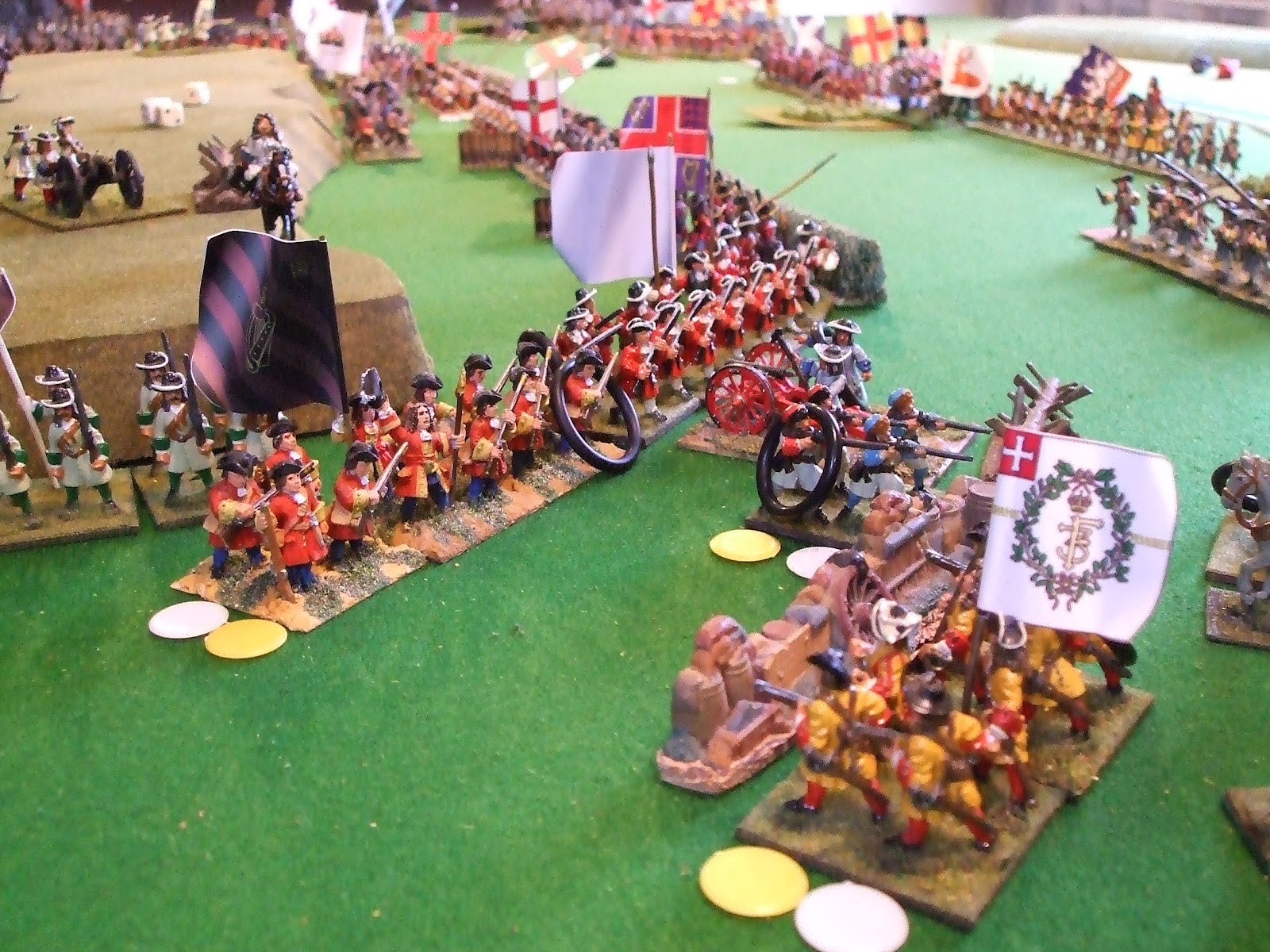
Friday, 22 June 2012

Germantown 1777

The second part of last weekend's wargames activities was the AGM of the Gentleman Pensioners on the Sunday.  Steve, our host, had set up the battle of Germantown and I was allocated one of the four  columns making up the American attack.  Historically, foggy conditions had made the co-ordination of the attack difficult and the confusion transferred itself across the years and into the wargames room as two of the trays holding the troops were mixed up and the artillery appeared on a different road to that intended!  A view from the British perspective can be found on Will McNally's AWI blog
Here is a link to a map of the action.  To further represent the difficulties of a night march the column commanders had to roll a dice to see if they had arrived on the field, two did, but two, including my column were delayed.


Dave commanding the column on the far right was soon in action, his rifles starting a firefight with a flank guard of Hessian jaegers.  Eventually the Hessians pulled back, but they had delayed the American column and given chance for the rest of Roy's command to form a defence line.  However, the dice had now decided that my troops could now enter the fray and from that moment on my knowledge of what was happening outside the range of my artillery is rather sketchy.

To my right Ian's column was making good progress down the road, but on hearing firing to his right he began to move in that direction, towards Chew House.  This strongpoint was ignored by Roy, who pulled back his light infantry towards Germantown, consolidating his position there.  At the time this was thought to be a mistake, especially as Dave's troops were by now making a determined attack on  Roy's left flank.

Leading my column were the cavalry, who quickly out distanced the infantry, ignored some flanking fire from British light infantry and galloped towards Germantown.  The riflemen, moved off the road to oppose the British troops who after firing another volley fell back towards the town.  This cleared the way for my artillery to take up its position on a low hill and begin firing at the British troops defending Germantown.  Roy had had difficulty getting his command organised (he was plagued by low dice rolls) but eventually a strong defensive position was established.  This was just as well for Chris's main column (with the elusive artillery) had now arrived and so all four American columns were bearing down on the British position.


My rifles were now lining a hedge with a clear view of the British defenders and my infantry battalions were deploying from the road to attack  the British right.  The cavalry thought that there was a chance to charge one of the British battalions in the open.  However, as they formed up to charge they were hit by a volley from the British infantry and before they could recover from that a second volley sent them tumbling back in a rout.

To my right Ian was trying to dislodge the British Light Companies from a hedge line and Chris was firing on the troops holding the church.  On the far right Dave was making valiant attempts to capture some of the Germantown buildings.


Roy had been casting anxious glances over his shoulder looking for reinforcements arriving and at last his prayers were answered.  Phil and Will arrived with their columns of reinforcements, one on each flank.  Part of Phil's infantry  deployed to face my battalions, but the grenadiers carried on up the road towards Ian's men.  Ahead of the grenadiers were the light dragoons.  They seemed to have a charmed life, passing through infantry and artillery fire without suffering any losses and moving quickly along the road to their front,  they were soon in the rear of the American position.

The grenadiers were not so lucky.  My riflemen did not miss when firing at them.  Several officers were hit and in confusion the grenadiers routed.  Success was brief however,  The American militia battalions could not face up to the British line in the open and, in what seemed like the blink of an eye, all three were routing back down the Limekiln Road.

Ian was also sustaining heavy losses.  His battalions had been unable to push back the Light Companies and two others had failed to stand when charged by the British troops.  He quickly established a second line of defence around the strongpoint of Chew House.
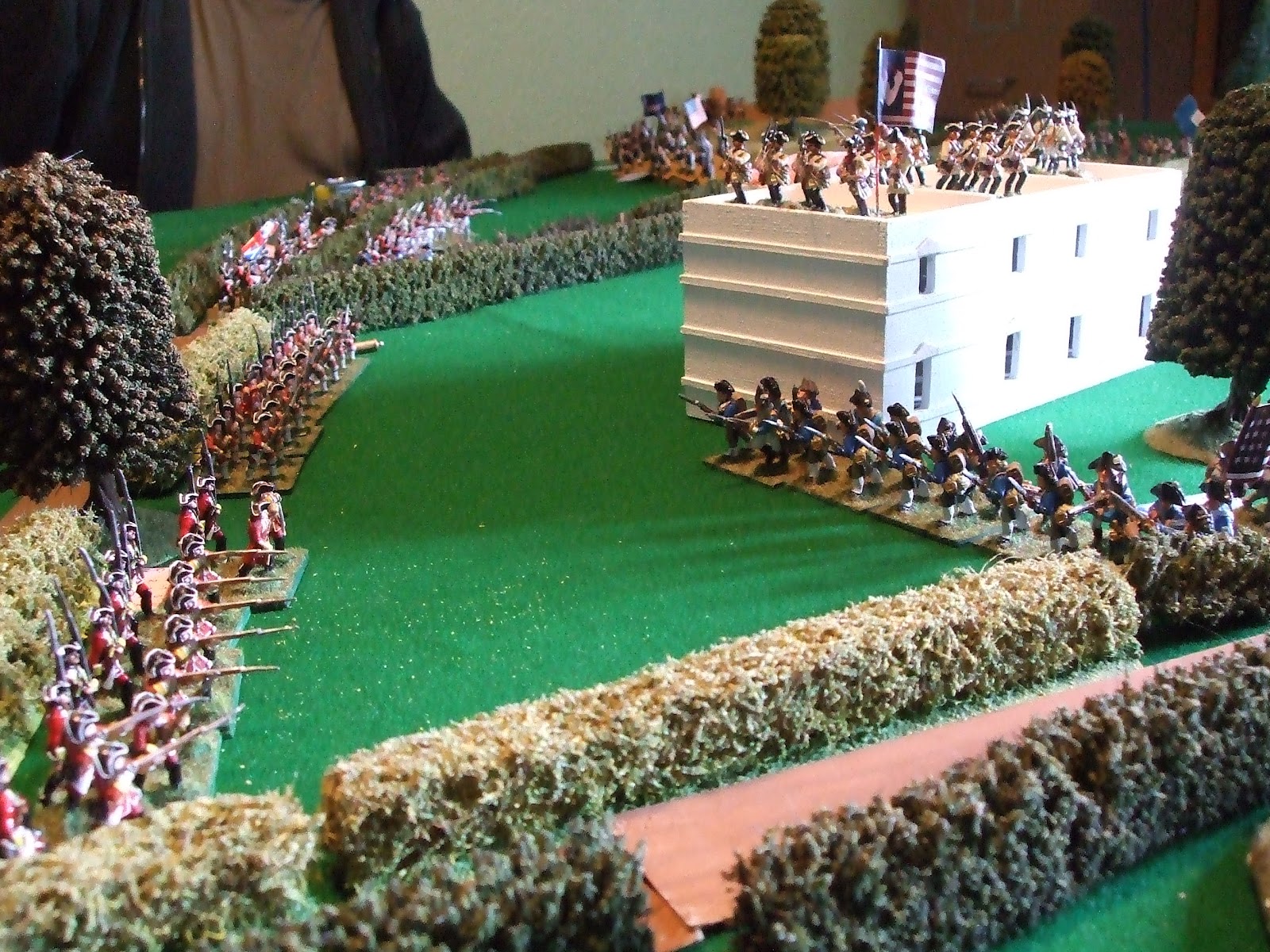


Chris had been holding his own against the Germantown defences, but the gun he had pushed forward to bolster the attack  had been abandoned by its crew when they were fired upon and seeing Ian pulling back, he too fell back.  Dave too had been forced onto the defensive due to heavy losses and the reinforcements from Will's column.

For me, total defeat was only a few moves away.  Phil's cavalry had moved round behind me.  I attempted to hold them off with my cavalry, but that failed, with my troops being swept away.  Phil's men then totally destroyed two of Ian's touting battalions and for 'afters' overran my battery.  On Limekiln Road one of my battalions had managed to rally to cover the rout of the rest and my riflemen were trying to hold back two advancing British battalions.  Inevitably, the rifles routed when charged and the militia pinned to their front by infantry volleys and attacked in flank also routed.  My command figure, wounded in the final British attack was captured by the all-conquering British Light Dragoons.

The troops around Chew House could see that both flanks were now 'in the air' and that they faced being trapped, so they too joined the general retreat and the action ended with a British victory.

Many thanks to Steve for umpiring the game and the 'Pensioners' for their good company. 


Wednesday, 20 June 2012

Phalanx 2012

The first part of a busy wargames weekend was a visit to the Phalanx show put on by the Saint Helens Spartans, a good mix of traders and games and usually you can find a bargain on the bring and buy.  This year I was helping out on the Lance & Longbow Society stand with their Ravenna game.
The French attack on the Spanish camp is a bit of a slogging match, especially between the rival groups of gendarmes.  The melee swung back and forth, eventually being decided in the French favour.  My fellow French commander was also able to overpower the Spanish guns and then cross the earth bank with his pikemen. This decided the battle in our favour.


My part had been to try and gain entry to the camp via the other entrance.  The light cavalry had battled hard, but made little progress, mainly because they had beem impetuous enough to mask their own guns.
A close, hard fought game using home grown rules which had been developed for use in participation games and therefore easy to use.

One game which particularly caught my eye was a Seven Years War action involving an Austro-Russian attack on a Prussian convoy.  The game was put on by Corbridge Old Contemptibles using the Rank and File rule set.


There was also a game representing the battle of Wartenburg 1813 put on by Loughborough Wargames.  This battle has interested me for some time, sparked by a magazine article by Peter Hofschroer.  The main problem is getting the terrain, which is very constricting, right; in particular the dykes and marshy woodland.  The Prussians have masses of troops, but can they get them in place to attack?  General de Brigade rules were used, making for large units.


Expenditure was pretty low this year, some river sections from S & A Scenics and some paint from Fighting 15's, I thought I'd try the Coat D'Arms Horse Tone paints which I haven't seen before. 


Friday, 15 June 2012

Sundeved 1848


We are back with the Schleswig War this week with the action at Sundeved. The Danes had bided their time and waited for the German allies of Schleswig to pull back.  The Danes then crossed to the Sundeved peninsula and pushed forward, hoping to defeat the Schleswig defenders in detail, before the supports could come up. The Danes also hoped for some naval support from the Als Fjord.


Here is a general view of the battlefield with Dybbol Mill, the Danish objective, in the far distance.  The Danes need to capture the villages to ensure their lines of communication.  The main effort was made up the lefthand road, directly towards Dybbol, with a flanking manoeuvre up the righthand road.

At first good progress was made, the 2nd Schleswig jaegers were driven out of the first village along the lefthand road and the flanking force, with artillery support easily captured the village on the right.  There was no sight of sails in the fjord, but the main force pushed on towards Stenderup.  Their progress was halted by a charge of the Oldenburg Dragoons

Their charge caught the supporting Danish artillery unawares, their shots went wide, and overran a unit of jaegers.  They then hit the 4th Infantry Regiment before they could deploy and scattered them to the winds.  However, the Oldenburg horsemen were now isolated from the rest of the Schleswig forces and were charged by a regiment of Danish dragoons, this forced them to retire, but they had delayed the Danish attack long enough for the garrison of Stenderup to be reinforced.

Slowly, the main Danish force advanced.  By the fjord they faced 4 battalions of Schleswig infantry who carried out a model fighting retreat.  Firing a volley as the Danes came in range and then falling back forcing the enemy to advance again.  Danish infantry approached Stenderup, whose outer defences were held by a militia battalion.  They repulsed the first attack, but were forced to withdraw when flanked by jaegers and fired on at close range by artillery.  This left the 2nd Schleswig jaeger as the garrison of the village.  Eager to make amends for their earlier retreat they forced a second attack to retreat and seemed invulnerable to close range artillery fire.

The Schleswig cavalry again intervened; the Schleswig dragoons routing a unit of Danish dragoons who were covering the flank of the attack on Stenderup.  The Danes did not stop running until they were over the pontoon bridge.  Like the Oldenburg Dragoons, the Schleswig Dragoons now found themselves isolated and found themselves surrounded by Danish cavalry.  They tried to cut their way to freedom, but very few made it and the unit played no further part in the action.  However, the Danes now found themselves under fire and one unit routed, again not stopping until it crossed the pontoon bridges.  In front of Stenderup the 6th Danish Infantry had sustained such heavy losses from rifle and artillery fire that it had to retire from action.  Two further units also retreated due to losses from the fire of the Schleswig troops covering the area between the fjord and the road.

The Danish commander was beginning to think it was not going to be his day.  "Where was the d....d navy?  They had promised him support".  Unfortunately, contrary winds had kept the navy at its moorings and the army was going to have to fight this battle on its own.  At least the flank attack on the right was making progress.  A third attack on Stenderup was organised, with troops coming in from three sides.  Amazingly the Schleswig jaegers held on.  Schleswig artillery stopped the attack from the right and jaeger volleys halted the other two attacks.  However, ammunition was now running low and further Danish units were readying for a fourth attack; this one with artillery support.  Firing off their remaining ammunition the jaeger fought like demons, but were forced by weight of numbers to give ground. 


As they reached the now fully manned Schleswig defences they received well deserved cheers from their comrades.  

It was now late in the day and the Schleswig commander believed his men had done enough to halt the Danes.  The militia had fought well, making good use of the ground to slow the advance and the cavalry had suffered losses but bought the time necessary to form a defence line.  For the Danish commander all he could do was try and hold what ground he had captured.  Several of his units would take time to recover from their losses and the officers of those units which had routed would need to be replaced.

This was a classic action where the ground made it difficult to make full use of superior numbers


Sunday, 3 June 2012

Maltrovo

This week's battle is a fictional scenario set in Eastern Europe in the 17th century.  Relations between Muscovy and the Cossacks blew hot and cold and at this particular time Muscovy was looking to extend its 'influence' to the south and west.  The Cossacks, valuing their independence, opposed this and the scene was set for conflict.  The two armies met at the small town of Maltrovo.  Leading the Muscovites was Prince Dmitri Pozhorski.  He had five units of streltsy and three units of feudal cavalry; the latter being under the command of Prince Petyr Rostov.
In addition he had a unit of German mercenary foot commanded by Gottfreid von Allenstein. and a field gun. 

Commanding the Cossacks was Borotnikov.  His main line consisted of three infantry units; on the left the Sodomirz Cossacks, in the centre the Godisz Cossacks and on the right, next to Maltrovo,Borotnikov's own regiment.  Maltrovo had a garrison of the Przemsyl Cossacks and also a unit of mercenaries under Captain Mohrungen, all under the command of Borodavka.  The cossacks placed all their cavalry on their left flank, opposite the Muscovite cavalry.  They had one light gun in Maltrovo and a second in the infantry line.


Pozhorski decided on a general advance by his streltsy to engage the Cossack foot in musketry. Once the enemy foot were weakened, he would attack with his cavalry.  Although he outnumbered the enemy, Pozhorski found it difficult to deploy all his men to shoot and although he was inflicting casualties, he was not gaining the advantage he sought.  However he was helped by a decision by Minin, the Cossack cavalry commander.  Interpreting the inactivity of the Muscovite cavalry as a general reluctance to fight, Minin sent forward a screen of cavalry to fire arrows, hoping to drive the enemy away. His action had the opposite effect.  Stung into action by the Cossack arrows, two units of feudal cavalry surged forward.  They had the advantage of numbers and mail shirts, but the Cossacks managed to hold the initial charge.  Minin sent forward the supporting squadrons and managed to maintain his position on the far left, but on his right, is cavalry were routed.


Hoping to plug the gap he led forward his last reserve and for a time this restored the balance.  Fighting bravely in the front rank Minin was cut down and what remained of his men routed.


Rostov acted quickly to steady his men and prevent them from pursuing the fleeing enemy.  Although Minin had failed to stop the feudal cavalry, his brave charge had bought the time for the Sodomirz Cossacks to redeploy to meet the flank attack by the cavalry.  This redeployment reduced the fire on the Voronsov and Barneskya streltsy and enabled them to concentrate their volleys on the Godicz Cossacks.  Godicz also had to contend with the Muscovite field gun which was firing with deadly effect, shot taking out files of men.  With losses approaching 50% Borotnikov ordered the Godicz Cossacks to fall back and become part of the garrison of Maltrovo.

In the town, Borodavka watched events keenly and saw an opportunity to attack the left flank of the Muscovites, which had been weakened by the fire of Borotnikov's Cossacks.  He therefore led out the garrison hoping to reduce the pressure on the Cossack centre.


On the Cossack left Rostov had now reformed his cavalry and began his attack on the Cossack centre.  One unit of feudal cavalry charged the Sodomirz Cossacks and were repulsed with heavy loss.  A second was more fortunate, they caught the retiring Godicz Cossacks.  Initially the infantry managed to stand against the feudal cavalry, but as more joined in the melee numbers began to tell and despite their bravery the infantry routed. 


Undeterred, the Sodomirz Cossacks held their position daring the cavalry opposing them to charge again.  But Rostov realised that a charge was not necessary.  he brought forward the Vorontsov streltsy to fire on the flank of the Cossacks, causing heavy casualties.   Seeing the danger looming over his force, Borotnikov joined his own regiment and redeployed them to cover Maltrovo.  The Muscovite artillery now shifted its attention to this unit and whilst urging his men to stand firm, Borotnikov was almost cut in two by a cannonball.  His aides quickly removed the body, but the infantry were shaken by this turn of events.

Pozhorski moved forward the Barneskya streltsy to fire at the Boronitkov Cossacks and a unit of feudal cavalry moved forward ready to charge.  The position was hopeless and the Cossacks surrendered; the victory was Pozhorski's.

But what about Borodavka's flank attack?  Well the Przemsyl Cossacks had been engaged in a musketry duel with Allenstein's men and the Ivanov streltsy.  To their right Mohrungen's men had continued to advance and were on the point of attacking the Hadiach streltsy when news came of the Cossack surrender.  Mohrungen's men now faced a decision, join Allenstein and replace the casualties he had suffered, or take their chance with Pozhorski.  Not surprisingly, Mohrungen joined their new 'comrades' in Von Allenstein's regiment.

Monday, 28 May 2012

Battle of Gogar 1650

The action this week comes from Cromwell's 1650 campaign in Scotland which culminated in the battle of Dunbar.  Prior to the decisive battle at Dunbar, Cromwell had twice attempted to draw the Scottish army out of the Edinburgh defences.  It was during the second attempt that the action at Gogar was fought.  The English forces were reaching ever further westwards, seeking a gap in the Scottish lines to try and establish a position on the Forth from which to strengthen their naval hold on the area.

The English force of three foot regiments, two horse regiments and a regiment of dragoons, augmented by a unit of firelocks and two light guns; faced a scratch defence of two Scottish foot regiments, two horse regiments, a unit of dismounted dragoons, a small unit of 'moss' troopers and some Highland archers.  The Scots also had one heavy gun and a frame gun.  The defence rested mainly on a redoubt by the village of Gogar.  Away to the east (Scots left) the Gogar Burn flowed in broad, shallow, meandering course between steep, muddy banks and marshy fields.  To the west low wooded hills made manoeuvre difficult.

The dice decided that I would command the Scots, and I at once began to reposition the reserve.  Maclean's Horse moved off to the left, hoping to outflank any attack on the redoubt.  Forbes Horse moved to the opposite flank to oppose a threatened attack by the English horse.  To my front the were the English foot and the first to advance were Skippon's who moved towards the redoubt. On their right were the firelocks and a Rainsborough's foot regiment; they moved towards my centre pinning my infantry and concentrating their artillery on the pike block holding the road past Gogar .

At first things seemed to be going well.  The dragoons were inflicting casulaties on Skippon's infantry and suffering little in return due to the stout breastwork.  The light frame gun was adding to the English infantry's discomfiture and just for good measure my snipers were taking pot shots at the officers.  Skippon's got within standard range and fired a couple of volleys, but their casualties, particularly amongst the officers lead to them having to fall back to rally.  The firelocks were also suffering, being fired on from front and flank; they suffered over 40% casualties before finding a position from which they could exact some revenge, firing volleys at the Scots musketeers supporting the pikes.

The English snipers now took a hand and from a rocky outcrop they fired a shot which picked off the Scots commander.  He was carried into Gogar 'Town House' where the local doctor did what he could, but with overall command now removed, each unit's colonel now made their own decisions.

On the English right the cavalry faced Forbes Horse across the river. Pistol shots were exchanged, but to little effect, until Forbes himself took a ball in the elbow.  He retired to the rear to have the wound dressed and without orders his men fell back too into the lee of a low mound.  The English horse, encouraged, crossed the muddy stream, but, before they could reform, Forbes second squadron appeared on their flank and charged.  The melee was confused, the English were on bigger horses and better armoured, but the Scots had the initial impetus.  Neither could gain an advantage until the arrival of Forbes with his reformed squadron, when the Scots began to gain the upper hand.

On the opposite flank Maclean's Horse continued on it flank ride.  It lost men to fire from the English dragoons, but pressed on, eventually reaching the English rear area.


But it was in the centre where affairs would be decided.  The pikes holding the road were coming under sustained fire from the light artillery and the English reserve infantry.  As losses mounted the survivors closed the ranks till only a pitiful handful remained.  With no officers left it fell to the oldest survivor to decide that they had done all they could and step by step they fell back towards their supports.  Seeing the opposition fall back the English reserve advanced and to their left Skippon's surged up the hill towards the redoubt.  The dragoons defending the redoubt had by now suffered heavy casualties and struggled to hold the English foot back.  The final infantry reserve had been held back to cover the road, but the commanding captain instead led it instead to aid the dragoons.


He was able to do this because the English foot attacking down the road had been targeted by the Scottish artillery and the musket reserve.  Packed together on the narrow road between the hill of Gogar and the Gogar Bog they had suffered heavy casualties.  To their front they saw Forbes Lancers and Captain Hoffman's 'Mossers', Skippons attack had stalled and Rainsborough's were losing the 
musketry battle to their right.


 To cap it all Cromwell was heading towards the rear with the cavalry.  Maclean's arrival had prompted this move and although they could not stand against the English horse their position was enough to convince Cromwell that a breakthrough at Gogar was not going to happen and he should therefore fall back on Musselburgh.

The Scots had the victory, but losses had been high and they were mighty glad to see the English leave the field.      

Friday, 25 May 2012

Holiday Reading

I have just finished reading a very interesting book called "City of Fortune: How Venice Won and Lost a Naval Empire" by Roger Crowley.  My background reading on the Crusades had already alerted to me to the influence of the Venetians in the 13th century, but I had not appreciated the full range of their impact.  In true wargamer fashion the 'butterfly' effect began to kick in, "wouldn't a small Venetian army be useful?, so many potential opponents, opportunities for land and naval actions."   The same sort of thing occurred a few years ago when I read John Julius Norwich's trilogy on Byzantium.  Before I knew it, I had the first (and up to press only) installment of my thematic Byzantine army raring to take on Bulgars, Khazars or any of the quite extensive list of potential opponents. (Even themselves if there was a coup!).  However, as you guessed, the butterfly only lingered for a short time before winging its way to another project.

So far I have managed to avoid plunging into  building a Renaissance Venetian force, though I was sorely tempted by the sight of some galleys at the Triples show....  That being said the Venetians could be set against Tartars, Ottomans, Pisans, Genoese, Hungarians or Norman settlers.  They could fight between themselves for control of disputed islands.  There could be small scale galley actions involving attacks on convoys- no need for dozens of models to refight Lepanto!  The most interesting part was the chapter on the siege of Venice in 1380 .  Genoa, aided by other Italian states and the Hungarians almost succeeded in defeating Venice.  There is plenty of potential for small scale raids on fortifications, actions between rival bands of condottieri and attempts to sink ships in channels to block supply routes.

If you have started to look around for a book to read whilst sunning yourself on holiday this summer Crowley's book may be worth a try.  His style can be a bit of an acquired taste, but if you can get beyond that there may be enough material to furnish several scenarios for those winter games nights.  The Junior General website can provide printable galleys and rules to dabble in the period if you do not want to inflict further damage on your wallet.

Tuesday, 22 May 2012

Aughrim 2

Last week the game was left with the point of decision being on the Jacobite right, where St Ruth was attempting to halt an advance by the Dutch and Danish infantry and cavalry.  The second evening began with Sarsfield leading forward his last unit of cavalry in a desperate attempt to buy time for reinforcements to arrive.  Sarsfield prevailed in the ensuing melee and rather recklessly pursued the defeated Dutch horse.  This resulted in the disordered Jacobites being caught by fresh cavalry and pursuit turned into rout as the remnants of Sarsfield's men tumbled from the field. 

Undaunted by this reverse, the cavalry commander turned to the cavalry reserve released by St Ruth and led that forward.  Again he suffered defeat, and had to turn to the final reserve which had been moved from the left flank.  Meanwhile the fire fight continued between the grenadiers defending the right flank and the guards battalions attacking them.  Heavy losses were suffered by both sides and soon only a few companies of powder-stained infantry remained with the colours.  The restricted front made it difficult for the Williamites to reinforce or extend the line, unlike the Jacobites , who benefited from the arrival of battalions from Lord Bellew's and the Grand Prior's regiments, who moved up on the right of the grenadiers.  An attempt by Ginkel to extend the line to the right, by moving Von Bulow's regiment forward was met by volleys from the 1st battalion of the Irish Guards who had been given the 'honour' of defending this 'knuckle' in the defence line.

Further along the line, the Jacobites continued to delay the advance by the English and Hugenot infantry and the left of the Jacobite line seemed secure from any advance.  To St Ruth the threat still lay on his right and here events were to take a dramatic turn for the worse.

The repulse of the Jacobite cavalry had allowed the Williamite cavalry to advance and deploy on a wider front.  This gave the Jurl regiment the freedom to deploy facing the flank of the Jacobite infantry line.  With their attention occupied by the infantry to their front, the men of Lord Bellew's regiment did not see the cavalry bearing down on them until it was too late to reform to meet the threat.  Already reduced in numbers by their fire fight with the Danish guards the Jacobite infantry did not stand, but turned and routed back up the hill towards the centre of St Ruth's position.  Sensing an opportunity, the colonel of the Jurl regiment urged on his men towards the flank of the next infantry unit.  This unit, the Grand Prior's regiment although fresh to action refused to stand when they saw colleagues routing past them.  Eventually the cavalry reined in at a fence blocking their path, in a few minutes they had destroyed the right flank of the Jacobite position.  The grenadiers, having stoutly stood their ground against heavy odds were demoralised by the sight of their supports routing away and also routed.  The 1st Battalion of the Guards were also forced into retreat by the flood of routers.

St Ruth hurriedly stripped yet more units from the 'quiet' sectors to cobble together a new line behind which he hoped to rally the fleeing units.  The second battalion of the Guards was ordered forward to fill the gap left by the first.  Stout work was done by the artillery, virtually the only unit on the Jacobite right to stand their ground.  They worked like demons firing as fast as they could at the advancing infantry.  However, they stood too long and as the infantry came in range their volleys quickly began to inflict casualties.  The rate of fire began to fall and soon there were too few to man the guns and the pitifully few survivors fell back.

Sarsfield had one last throw of the dice and led forward is final reserve.  This met the last uncommitted Williamite cavalry in a fierce melee which involved both brigade commanders.  Eventually the Jacobites prevailed, but as the cavalry regrouped they found the body of Sarsfield amongst a group of dead enemy horsemen.  The Williamite cavalry were destroyed, but the Jacobite cavalry were too few in number to operate as a viable threat to the Williamite infantry, so they formed up and slowly gave ground in front of a cautious enemy advance.

Elsewhere the English and Hugenots had taken advantage of the thinning of the Jacobite lines to move forward and in some places had reached the main defence line.  Uncertainty about events on the flanks caused some wavering in the infantry units and anxious glances over the shoulder were not eased by increasingly strident commands to 'look to your front'  The grenadiers attached to the Hugenot brigade had attacked the second battalion of the Irish Guards as they attempted to hold the 'knuckle' and in a fierce melee forced the Irishmen to give ground.  As these elite troops grudgingly fell back St Ruth realised that the day was lost and the best strategy was to preserve as much of the army as possible for the next battle.

Taking advantage of the gathering gloom and the weariness of the Williamite forces the Jacobites began to  retreat down the road towards Galway.